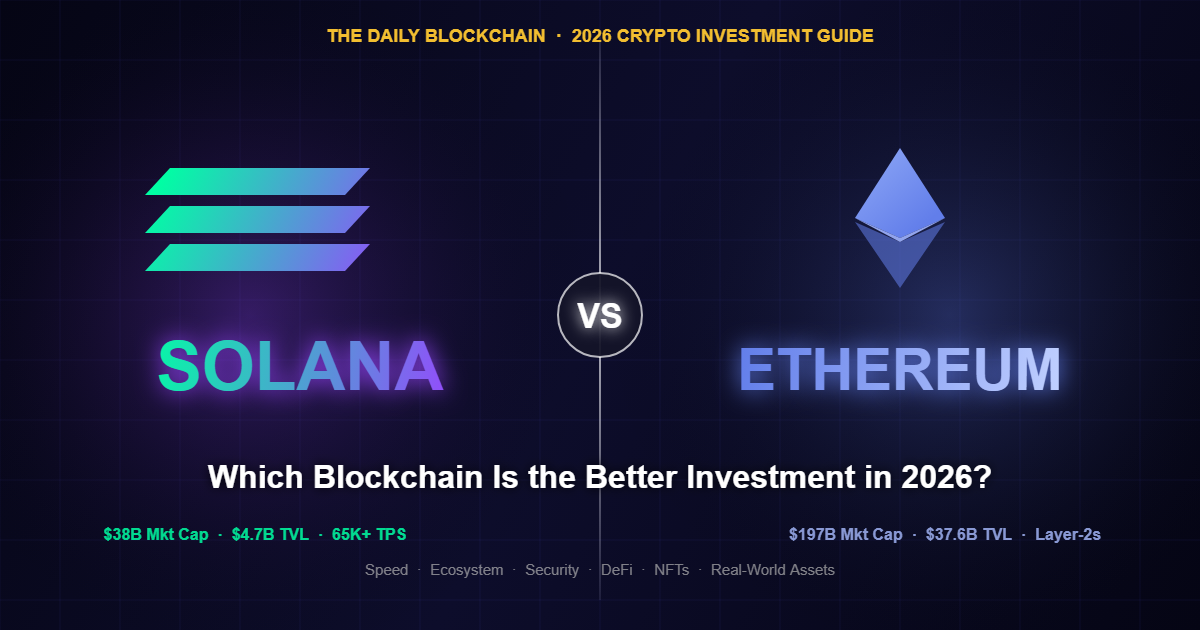
Solana vs Ethereum 2026 — it’s the most debated question in crypto investing right now. In this comprehensive Solana vs Ethereum 2026 guide, we break down every key metric with real data to help you make an informed investment decision. Both networks have survived bear markets, upgraded their technology, attracted institutional money, and built thriving ecosystems — but they represent fundamentally different bets. This Solana vs Ethereum 2026 comparison covers speed, DeFi TVL, DEX volume, RWA tokenization, payments, security, and price predictions. Which blockchain deserves your capital in 2026? Read on to find out.
The 2026 Landscape: Where Each Chain Stands Today
As of June 2026, the blockchain sector has matured dramatically. Institutional adoption is no longer a talking point — it’s a reality. Real-World Asset (RWA) tokenization has crossed tens of billions of dollars across major chains. Stablecoin volumes dwarf traditional payment rails. In the Solana vs Ethereum 2026 debate, two networks remain at the center: Ethereum (ETH), the battle-tested layer-1 that pioneered smart contracts, and Solana (SOL), the high-speed challenger disrupting assumptions about what a blockchain can do.
| Metric | Solana (SOL) | Ethereum (ETH) |
|---|---|---|
| Price (June 2026) | ~$65 | ~$1,628 |
| Market Cap | ~$37.9B | ~$196.6B |
| DeFi TVL | $4.69B | $37.58B |
| Stablecoin Supply | $15.2B | $156.9B |
| RWA Mcap | $1.79B | $14.66B |
| DEX Volume (24h) | $1.94B | $825M |
| Chain Fees (24h) | $379K | $271K |
| NFT Volume (24h) | $133K | $648K |
| Bridged TVL | $27.4B | $340.1B |
Source: DefiLlama, June 2026. Data is approximate and changes daily.
Speed and Scalability: Solana’s Biggest Weapon
If there is one area where Solana has definitively won the argument, it’s raw throughput. Solana’s architecture — built around Proof of History (PoH) and a parallel transaction processing system — delivers theoretical speeds exceeding 65,000 transactions per second (TPS) with sub-second finality and average fees of fractions of a cent. In practice, real-world throughput regularly exceeds 3,000–4,000 TPS, dwarfing Ethereum’s base layer of 15–30 TPS.
Solana’s 2026 commitment to bare-metal hardware validators reinforces this advantage. As announced in June 2026, validators are required to run on dedicated hardware — not cloud VMs — ensuring the chain keeps pace with next-generation performance demands. This decision signals Solana’s serious, long-term commitment to being the world’s fastest production-grade blockchain. For more on how blockchain technology intersects with emerging tech, see our guide on AI Agents in 2026.
Ethereum, by contrast, has long delegated speed to its Layer-2 ecosystem. Networks like Arbitrum, Optimism, Base, and zkSync provide fast, cheap transactions while settling to Ethereum’s secure base layer. This approach works — and works well — but it fragments liquidity and user experience across multiple chains. In 2026, Ethereum’s Layer-2 ecosystem processes far more transactions than its base layer, with Base alone handling millions of transactions daily.
Verdict: Speed
Solana wins for raw speed and seamless user experience on a single chain. Ethereum’s modular Layer-2 strategy closes the gap but introduces complexity.
DeFi Dominance: Ethereum Still Leads, But the Gap Is Narrowing
Ethereum’s DeFi Total Value Locked (TVL) of $37.58 billion dwarfs Solana’s $4.69 billion — a roughly 8x advantage. The Ethereum ecosystem hosts the blue-chip DeFi protocols: Aave ($10.18B TVL), Lido ($14.89B), Sky (formerly MakerDAO, $5.87B), and EigenLayer ($4.54B in restaking). These protocols have years of battle-testing, institutional-grade audits, and deep liquidity moats. According to DefiLlama’s Ethereum chain data, Ethereum’s DeFi ecosystem remains the largest by a significant margin.
But look at daily DEX volume and the picture shifts. Solana’s DEX ecosystem generated $1.94 billion in 24-hour volume versus Ethereum’s $825 million — more than double. Jupiter ($1.48B TVL), Raydium ($818M), and Kamino ($1.19B) power Solana’s DeFi machine. Solana’s app revenue of $2.86M per day versus Ethereum’s $1.38M reveals that value is being generated on Solana at a pace the market may be underpricing. In the Solana vs Ethereum 2026 DeFi showdown, both chains have compelling stories to tell. Check our related article on Top Altcoins for 2025-2026 for more investment context.
Solana’s stablecoin supply of $15.2 billion — while significantly lower than Ethereum’s $156.9 billion — has been growing rapidly. The May 2026 ecosystem roundup recorded an all-time high stablecoin supply of $16.4B on Solana, up dramatically year-over-year. According to DefiLlama’s stablecoin tracker, Solana’s stablecoin growth rate in 2026 is among the fastest of any major blockchain.
Verdict: DeFi
Ethereum wins on total capital locked. Solana wins on daily trading activity and growth momentum. For conservative capital allocation, Ethereum is safer.
Real-World Assets and Institutional Adoption
RWA tokenization is the defining trend of 2026 — and a key battleground in the Solana vs Ethereum 2026 rivalry. Ethereum leads with $14.66 billion in active RWA market cap — nearly 8x Solana’s $1.79B. Protocols like Ondo Finance, Centrifuge, and BlackRock’s BUIDL fund have chosen Ethereum for its security guarantees and institutional-grade infrastructure. According to RWA.xyz, Ethereum commands over 60% of all tokenized real-world asset value globally.
Solana is catching up aggressively. The May 2026 ecosystem report revealed Solana’s RWA market cap hit an all-time high of $2.8 billion, with 97% of tokenized equities on Solana settling through the network. Ventures like Oro (tokenized gold) and MoneyGram’s institutional validator partnership (June 2026) demonstrate Solana’s aggressive push into TradFi. The Accelerate USA 2026 conference in Miami brought major banks and traditional finance institutions to Solana — a signal that institutional interest is not limited to Ethereum. For broader context, see our analysis of blockchain innovation trends in 2026.
Verdict: RWA / Institutional
Ethereum leads in absolute RWA value and regulatory trust. Solana is growing faster and positioning itself as the settlement layer for payments and consumer-facing financial products.
Payments and Consumer Adoption: Solana’s Killer App
One of the most significant developments in the Solana vs Ethereum 2026 comparison is Solana’s aggressive push into mainstream payments. In June 2026, Solana launched native on-chain subscriptions and allowances — recurring payments and delegated spending as shared on-chain primitives. This positions Solana as a genuine alternative to Visa and Stripe for subscription-based businesses.
Solana Pay is live at major retailers. The World Series of Poker now accepts crypto tournament entries directly on Solana with zero processing fees. MoneyGram’s integration brings global remittance corridors to the chain. The vision is clear: Solana wants to be the payment rail for the internet economy. According to Solana’s official newsroom, ecosystem stablecoin supply hit an all-time high of $16.4B in May 2026, validating the payments thesis.
Ethereum’s payment story in 2026 is largely told through stablecoins on Layer-2s, particularly Base (backed by Coinbase) which has become a dominant consumer app platform. Ethereum’s stablecoin dominance ($156.9B vs. Solana’s $15.2B) reflects its established status as the global liquidity backbone. For more on crypto market dynamics, read our Crypto Market Analysis.
Verdict: Payments
Solana wins on consumer-facing payment UX, speed, and fee costs. Ethereum wins on stablecoin liquidity depth.
NFTs and Gaming: A Market in Transition
The NFT market has evolved significantly since the 2021–2022 peak. Ethereum currently leads in 24-hour NFT volume ($648K vs. Solana’s $133K), largely because the highest-value NFT collections — Bored Apes, CryptoPunks, Art Blocks — remain on Ethereum. According to NFTGo’s market data, Ethereum blue-chip collections still command 70%+ of total NFT market capitalization.
In 2026, Solana’s NFT ecosystem is pivoting toward gaming, sports fan tokens (Fantasy, prediction markets, and licensed Fan Tokens from Chiliz are now live), and utility NFTs. Its sports-industry focus — betting, fantasy leagues, and ticketing — opens a $400B+ market. This pivot is a key factor in the Solana vs Ethereum 2026 NFT comparison. You can track real-time NFT data on DefiLlama.
Verdict: NFTs
Ethereum wins for high-value art and blue-chip collections. Solana wins for gaming, sports, and high-frequency low-cost NFT use cases.
Security, Decentralization, and Network Reliability
Ethereum’s greatest competitive moat is its security and decentralization. With over 900,000 validators secured by Proof of Stake, a decade of hardened smart contract infrastructure, and the largest developer ecosystem in crypto (4,000+ active monthly developers), Ethereum is the most battle-tested smart contract platform in existence. Its bridged TVL of $340 billion — versus Solana’s $27.4B — reflects extraordinary institutional trust. This security advantage is arguably the most important factor in the Solana vs Ethereum 2026 debate for institutional investors.
Solana has faced criticism for network outages in previous years, though reliability has improved dramatically. The 2026 shift to bare-metal validator hardware standardizes on high-performance dedicated servers, reducing variability that contributed to past congestion events. Ethereum’s restaking ecosystem, led by EigenLayer ($4.54B), extends security to third-party networks — a fundamentally new paradigm.
Verdict: Security & Decentralization
Ethereum wins decisively. Its security track record, validator count, and developer ecosystem make it the gold standard for institutional capital allocation.
Developer Ecosystem and Tooling
Ethereum’s developer ecosystem remains the largest in crypto. Solidity is the most widely taught smart contract language. The EVM (Ethereum Virtual Machine) compatibility has created a network effect: any chain that supports EVM — Polygon, Avalanche, BNB Chain, Layer-2s — can port Ethereum code directly. According to Electric Capital’s Developer Report, Ethereum consistently leads all chains in monthly active developers.
Solana uses Rust for smart contracts, which has a steeper learning curve but produces highly efficient, low-level code. The Solana Developer Platform offers API-driven infrastructure that simplifies building payment-focused applications — a direct play for fintech developers. MoneyGram’s addition as an infrastructure partner in June 2026 signals enterprise-grade tooling is maturing on Solana. The developer ecosystem gap is a key consideration when analyzing Solana vs Ethereum 2026 as a long-term investment. Also see our guide on how AI is transforming blockchain development in 2026.
Verdict: Developer Ecosystem
Ethereum wins on breadth and maturity. Solana wins on payment-focused and high-performance application development.
Tokenomics and Supply Dynamics
Ethereum’s market cap of $196.6 billion reflects its status as the second-largest cryptocurrency. Post-Merge, Ethereum’s issuance has been significantly reduced, and the EIP-1559 fee-burning mechanism makes ETH deflationary during high-usage periods. This deflationary narrative is one of Ethereum’s strongest investment theses in the Solana vs Ethereum 2026 comparison.
Solana’s market cap of $37.9 billion (FDV $41.1B) is significantly smaller — higher risk, but substantially higher upside potential. SOL’s current price of approximately $65 represents a significant discount from its all-time high, while network activity metrics (DEX volume, stablecoin supply, RWA growth) have been hitting all-time highs. Solana’s staking yield (approximately 6–8% annually) provides genuine income for holders, making it attractive for long-term investors. Read our Bitcoin Price Prediction 2026 for broader crypto market cycle context.
Verdict: Tokenomics
Ethereum offers a mature, deflationary store-of-value narrative. Solana offers a higher-risk, higher-reward growth equity-style investment with staking yield.
2026 Price Predictions and Investment Outlook
Any price prediction in crypto comes with enormous uncertainty. However, we can frame the Solana vs Ethereum 2026 investment thesis based on real fundamentals. This is not financial advice.
Ethereum (ETH) Bull Case: If ETH ETF inflows continue, institutional RWA adoption accelerates, and EigenLayer restaking creates new utility flywheel effects, ETH could re-rate toward its previous all-time high range. Ethereum’s dominant stablecoin supply ($156.9B) and bridged TVL ($340B) suggest massive economic activity continues to settle on or through Ethereum. A recovery to prior highs would represent 2–4x from current levels for patient investors.
Ethereum (ETH) Bear Case: Layer-2 fragmentation could reduce demand for ETH as gas, suppressing fee burns and weakening the deflationary narrative. Competition from Solana, Base, and other EVM chains could limit ETH’s productive asset narrative.
Solana (SOL) Bull Case: Solana’s DEX volume, stablecoin ATHs, RWA growth, payments infrastructure, sports sponsorships, and institutional validator partners point to a network monetizing its speed advantage faster than the market price reflects. If SOL can close even 30% of the TVL gap with Ethereum, the market cap re-rating could be substantial.
Solana (SOL) Bear Case: Network outage risk remains. Validator concentration concerns haven’t fully resolved. If Ethereum’s Layer-2s absorb the high-throughput consumer use case, Solana’s primary differentiator diminishes. This risk asymmetry is central to the Solana vs Ethereum 2026 investment decision.
Head-to-Head Summary: Solana vs Ethereum 2026
| Category | Winner | Notes |
|---|---|---|
| Transaction Speed | 🟢 Solana | 65K+ TPS vs ETH’s 15–30 TPS base layer |
| DeFi TVL | 🔵 Ethereum | $37.6B vs $4.7B — 8x advantage |
| DEX Trading Volume | 🟢 Solana | $1.94B/day vs $825M/day |
| Stablecoin Liquidity | 🔵 Ethereum | $156.9B vs $15.2B — dominant |
| RWA Tokenization | 🔵 Ethereum | $14.7B vs $1.8B — but Solana growing fast |
| Payments & Consumer UX | 🟢 Solana | Low fees, subscriptions, WSOP, MoneyGram |
| Security & Decentralization | 🔵 Ethereum | 900K+ validators, decade-tested |
| NFTs (High-Value) | 🔵 Ethereum | Blue-chip collections remain on ETH |
| NFTs (Gaming/Sports) | 🟢 Solana | Fan tokens, sports betting, low-cost assets |
| Developer Ecosystem | 🔵 Ethereum | Largest dev community, EVM compatibility |
| Growth Momentum | 🟢 Solana | DEX ATHs, stablecoin ATHs, RWA ATHs in 2026 |
| Market Cap Upside | 🟢 Solana | Smaller cap = higher asymmetric upside potential |
Which Is the Better Investment in 2026?
The honest answer to the Solana vs Ethereum 2026 question is: it depends on your investment profile.
Choose Ethereum if: You prioritize capital preservation and institutional-grade security. You want exposure to the chain that holds the majority of DeFi, stablecoin, and RWA value. You believe Ethereum’s Layer-2 modular strategy will win long-term. Ethereum remains the “safe” large-cap choice in the crypto asset class.
Choose Solana if: You have a higher risk tolerance and want exposure to an asset whose fundamental activity metrics are hitting all-time highs while the price remains 70%+ below its ATH. You believe payments, sports, consumer apps, and RWA growth will drive the next wave of adoption. Solana’s staking yield (6–8% annually) adds income on top of price appreciation potential. For more on altcoin investing, see our Top Altcoins Investment Guide.
The pragmatic 2026 portfolio approach: Many sophisticated crypto investors are holding both. Ethereum provides the defensive base. Solana provides the asymmetric growth kicker. A 60/40 or 70/30 ETH/SOL split captures both narratives. Stay updated on the latest analysis at The Daily Blockchain.
Frequently Asked Questions: Solana vs Ethereum 2026
Is Solana better than Ethereum in 2026? Solana is faster and cheaper, with stronger growth momentum in DEX volume, payments, and stablecoins. Ethereum leads in TVL, security, stablecoin supply, and developer ecosystem. In the Solana vs Ethereum 2026 comparison, neither is definitively “better” — they serve different investment profiles.
Will Solana overtake Ethereum in market cap? As of June 2026, Ethereum’s market cap ($196.6B) is roughly 5x Solana’s ($37.9B). Overtaking Ethereum would require an extraordinary catalyst, but narrowing the gap significantly is plausible given Solana’s growth metrics.
Which has better staking rewards in 2026? Solana offers approximately 6–8% annual staking yield. Ethereum’s staking yield via Lido and similar protocols ranges from 3–5%. Solana currently offers higher nominal yield.
Is the Solana vs Ethereum 2026 choice a good investment overall? Both represent legitimate investment cases at current prices. The right choice depends on risk tolerance, investment horizon, and belief in each chain’s ecosystem roadmap. Always conduct your own research and consult a qualified financial advisor.
Final Thoughts
The Solana vs Ethereum 2026 debate is not about survival — both networks have proven their staying power. It is about which blockchain will capture more of the value created as crypto becomes the infrastructure of the global digital economy. Ethereum holds the capital. Solana is capturing the activity. The most informed investors are watching both — and positioning accordingly. For the latest updates, follow The Daily Blockchain.
Disclaimer: This article is for informational and educational purposes only. Nothing in this post constitutes financial, investment, or legal advice. Always conduct your own research and consult with a qualified financial advisor before making any investment decisions. Cryptocurrency investments carry significant risk, including the potential loss of all invested capital.