Tokenized stocks are having the year that tokenized treasuries had in 2024. In June 2025 the entire category was worth about $2 million. By August 2026 it sits somewhere near $2.5 billion, Nasdaq has SEC approval to trade equities in tokenized form, and roughly 903 different tokenized equities are tracked on-chain. That is a genuinely large shift in fourteen months.
It is also one of the most misunderstood corners of crypto. The single most important fact about most tokenized stocks available to retail buyers today is this: buying one usually does not make you a shareholder. Kraken’s own disclosures say its xStocks products “do not confer shareholder rights like voting or dividends” and provide “no legal claims” to the underlying shares — and roughly $25 billion has changed hands in them anyway.
This guide explains what tokenized stocks actually are, how the three competing models differ, what the 2026 regulatory picture looks like after the SEC’s Nasdaq approval, where you can buy them, and the risks that rarely make it into the marketing. All figures are dated and sourced.
Key takeaways
- A tokenized stock is a blockchain token whose value tracks a real share. Depending on the model, it may or may not give you any legal claim on that share.
- Size, as of 25 August 2026: tokenized equities are worth roughly $2.5 billion inside a $38.2 billion tokenized real-world asset market — about 6.5% of the total.
- Three models exist. 1:1 backed wrappers dominate and carry no voting rights. Issuer-led native issuance carries full rights but is rare. Synthetic exposure holds nothing at all.
- Regulation moved fast. The SEC approved Nasdaq’s tokenized trading rule on 19 March 2026, but that covers Russell 1000 stocks and index ETFs settling T+1 through the DTC — not the offshore wrapper tokens most retail buyers can access.
- US retail is largely excluded from the wrapper products. xStocks and similar tokens are restricted to non-US clients.
- Forecasts disagree wildly: McKinsey says under $2 trillion of tokenized assets by 2030; BCG says $16 trillion. Both are forecasting from a $38 billion base.
What are tokenized stocks?
Tokenized stocks are blockchain-based tokens that represent exposure to shares in a publicly listed company. A token called TSLAx tracks the price of Tesla stock; a token called NVDAx tracks Nvidia. They trade around the clock on public blockchains such as Solana, Ethereum and TON, settle in seconds rather than the traditional one-day cycle, and can be moved into a self-custody wallet or used inside decentralised finance protocols.
That is the pitch. The mechanics underneath vary enormously, and so does what you legally own. In the most common structure, an issuer buys a real share on a traditional exchange, deposits it with a regulated custodian, and mints a matching token on-chain. Redeeming the token reverses the process. You hold a contractual claim against the issuer — not a position on the company’s shareholder register.
Tokenized stocks sit inside the broader real-world asset (RWA) category, alongside tokenized US Treasuries, gold, private credit and corporate bonds. Equities are one of the newest and fastest-growing slices of that market, but still one of the smallest.
How big is the tokenized stocks market in 2026?
As of 25 August 2026, RWA.xyz tracks $38.18 billion in distributed on-chain value across tokenized real-world assets, held by roughly 2.8 million wallets. Stablecoins, which are counted separately, add another $302 billion. Ethereum remains the largest venue with about $17.3 billion across 2,090 RWA tokens.
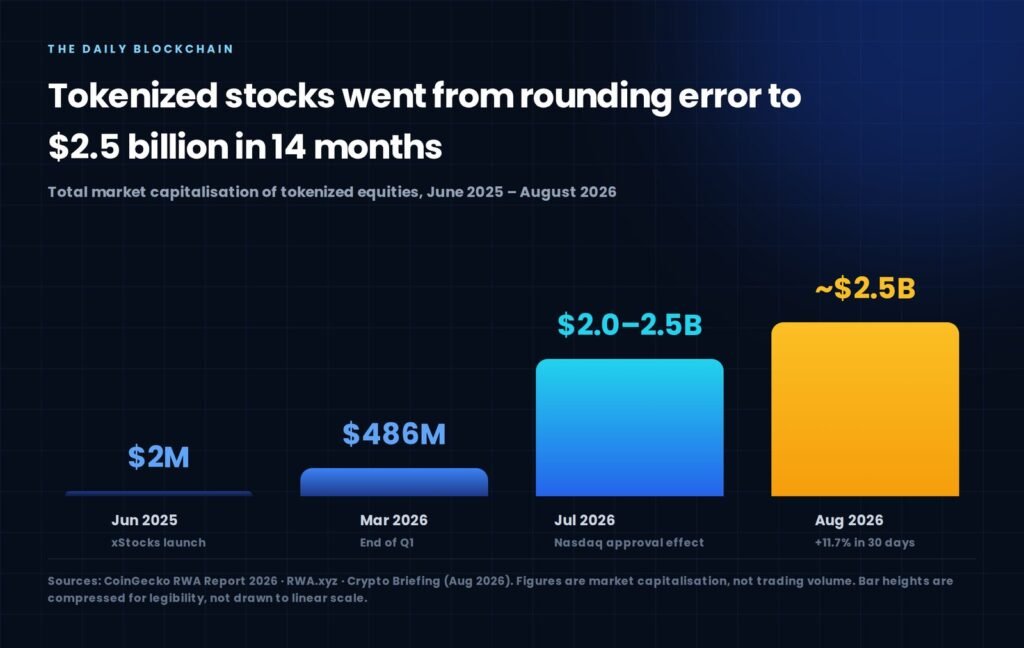
Within that market, tokenized stocks have gone from negligible to meaningful very quickly:
- June 2025: roughly $2 million in total market capitalisation, at the launch of Backed Finance’s xStocks.
- 31 March 2026: $486 million, or 2.5% of the $19.3 billion RWA market measured in CoinGecko’s RWA Report 2026.
- July 2026: $2 billion to $2.5 billion, following the Nasdaq approval.
- August 2026: approximately $2.5 billion, up 11.7% over 30 days, held by around 1.18 million wallets.
Trading activity has outpaced market cap growth. CoinGecko recorded $15.1 billion in spot trading of tokenized stocks during Q1 2026 alone — more than the $14.8 billion traded across the whole second half of 2025. Kraken’s xStocks has processed roughly $25 billion in cumulative transaction volume, with more than $4 billion settling directly on-chain.
Put in context, though, $2.5 billion of tokenized stocks against a $38.2 billion RWA market is about 6.5%. And against the roughly $14 trillion of value listed on Nasdaq alone, it is a rounding error. Tokenized treasuries and tokenized commodities are still far larger: at the end of Q1 2026 treasuries accounted for 67.2% of tokenized RWAs and gold-backed tokens such as Tether Gold and Pax Gold made up another 28.7%.
How tokenized stocks work: the three models
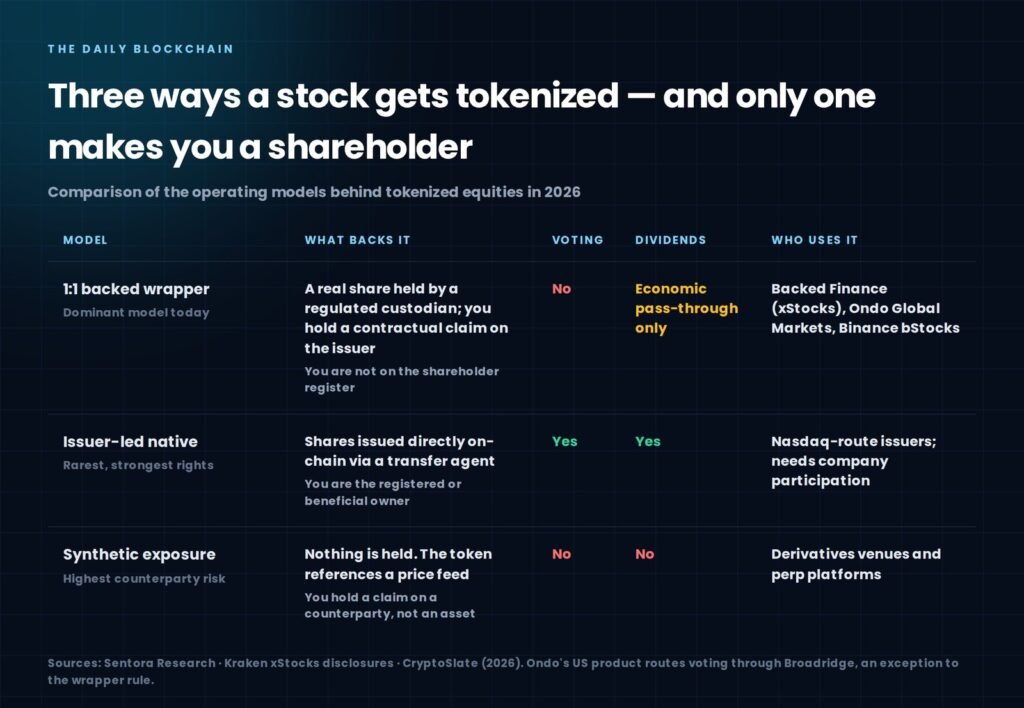
This is the section most guides skip, and it is the one that determines whether you own an asset, a promise, or a price feed. Research from Sentora maps three distinct structures operating in 2026.
1. The 1:1 backed wrapper (dominant today)
An issuer buys the share, a regulated custodian holds it, and a token is minted against it. Backed Finance’s xStocks, Ondo Global Markets and Binance’s bStocks all use variants of this. The backing is real, but the token is a claim on the issuer rather than on the company. If the issuer fails, your recovery depends on its jurisdiction, its bankruptcy structure and whether the custodian genuinely segregated assets.
Dividends are typically passed through economically, net of withholding tax. Voting is not. The custodian votes or abstains under a standing policy, and you have no say. Ondo’s US product is a notable exception — it routes voting through Broadridge infrastructure, getting closer to the rights a registered shareholder holds.
2. Issuer-led native issuance (rarest, strongest)
Here the company itself issues shares on-chain through a transfer agent. Token holders become registered or beneficial owners with full voting rights, dividend entitlement and legal claims. This is the model the Nasdaq route enables. Its limitation is obvious: it needs the listed company to actively participate, which caps how fast coverage can expand.
3. Synthetic exposure (highest counterparty risk)
The token references a share price without anyone holding the share. There is no custodian and no asset — only a counterparty obligation. Volumes on RWA perpetual products are substantial (CoinGecko logged $524.8 billion in Q1 2026 alone), but these serve traders, not long-term allocators. If you are looking for equity exposure to hold, this is the model to understand before you touch it.
What rights do you actually get?
Short answer: with the tokenized stocks most retail traders can access, almost none of the rights you would associate with owning shares.
Kraken’s xStocks FAQ is explicit that its tokens do not confer voting or dividend rights and give holders no legal claim to the underlying shares. That disclosure exists, it is public, and roughly $25 billion has still traded through the product across Solana, Ethereum and TON — held by more than 85,000 unique addresses. The gap between what buyers assume and what the paperwork says is the central risk in this market right now.
Nasdaq’s approved structure is the opposite. Both conventional and tokenized shares carry identical rights; the only difference is the delivery format. Voting, dividends, proxy actions and legal claims to residual assets all remain intact because the tokenized share is connected to the official ownership registry.
So the practical rule is: check which model your token uses before you assume anything. The word “tokenized” on an exchange listing page tells you nothing about your legal position.
Tokenized stocks regulation in 2026
2026 was the year the US regulatory picture went from ambiguous to structured. Four developments matter.
The DTC no-action letter (December 2025)
The SEC permitted the Depository Trust Company to tokenize securities after trades settle. This is the plumbing that makes everything else possible.
The Nasdaq approval (19 March 2026)
The SEC approved a Nasdaq rule change allowing tokenized securities to trade on the same order books as conventional shares. Important limits apply: it covers Russell 1000 stocks and index ETFs, settlement remains conventional T+1 through existing infrastructure, and buyers choose a tokenization flag and blockchain preference at purchase. Nasdaq is targeting operational readiness in the first half of 2027, and DTCC plans to explore digital cash settlement in 2027 to enable genuine instant settlement. NYSE’s parent ICE announced a competing tokenized platform in January 2026.
Regulation Crypto Assets (proposed 18 August 2026)
The SEC proposed a framework with two registration exemptions — a startup exemption capped at $5 million over four years, and a Regulation A-style fundraising exemption at $20 million (Tier 1) or $75 million (Tier 2) annually — plus a safe harbour from investment contract classification once a network operates autonomously. Law firm analysis from Skadden notes that tokenized equity offerings would generally not qualify for these exemptions. Traditional securities law continues to apply to tokenized stocks.
The offshore gap
None of the above legalises the wrapper tokens for US retail investors. Products like xStocks remain restricted to non-US clients. The World Federation of Exchanges has written to global regulators arguing that tokenized stocks “lack the safeguards that protect investors in traditional markets” and pressing the SEC and European watchdogs to apply full securities standards — custody requirements, disclosure obligations, investor protections. That regulatory asymmetry — approved institutional rails in the US, unapproved retail wrappers offshore — is the defining tension of the tokenized stocks market heading into 2027.
Where to buy tokenized stocks (and who is locked out)
Availability depends almost entirely on where you live. The main venues in August 2026:
| Platform | Product | Model | Availability |
|---|---|---|---|
| Kraken | xStocks (Backed Finance) | 1:1 wrapper | Non-US clients only |
| Binance | bStocks | 1:1 wrapper | Selected non-US markets |
| Ondo Finance | Ondo Global Markets | 1:1 wrapper, US voting via Broadridge | Varies by jurisdiction |
| Nasdaq | Tokenized Russell 1000 shares and ETFs | Issuer-led native | Targeting H1 2027 readiness |
| NYSE / ICE | Announced platform | Institutional | Announced January 2026 |
Practically, buying tokenized stocks today means opening an account on a centralised exchange that lists them, completing KYC, funding with a stablecoin such as USDC, and either trading on the exchange or withdrawing the token to a self-custody wallet on Solana or Ethereum. If you are choosing a venue, our comparison of the best crypto exchanges in 2026 covers fees and security, and our guide to securing digital assets in a wallet is worth reading before you self-custody anything.
Chain choice matters more than it first appears. Liquidity for tokenized stocks is fragmented across Solana, Ethereum and TON, and thin books mean wider spreads. Our breakdown of Solana vs Ethereum in 2026 explains the trade-offs in cost and depth.
Seven risks of tokenized stocks that rarely appear in the marketing
- You are usually not a shareholder. No votes, no register entry, no direct legal claim on the company in most wrapper products.
- Issuer and custodian risk. Your claim is only as good as the issuer’s solvency, its jurisdiction’s bankruptcy law, and whether the custodian actually segregated the shares. Audit quality varies.
- Thin off-hours pricing. Tokens trade 24/7, but the underlying market does not. Price formation while Nasdaq is closed is shallow, and spreads widen accordingly.
- Redemption is still T+1. Secondary transfers settle in seconds, but creating and redeeming tokens still runs through conventional settlement. The instant-settlement benefit is narrower than advertised.
- Regulatory reversal risk. The World Federation of Exchanges has formally asked regulators to crack down on offshore wrapper products. A rule change could strand liquidity.
- Fragmented liquidity. The same stock exists as separate tokens on separate chains from separate issuers, splitting order books.
- Tax treatment is unsettled. How a tokenized share is treated for capital gains, dividend withholding and reporting varies by jurisdiction. Our overview of cryptocurrency taxation guidelines is a starting point, not a substitute for an accountant.
Tokenized stocks vs a brokerage account vs CFDs
| Tokenized stock (wrapper) | Traditional brokerage | CFD | |
|---|---|---|---|
| Own the share | No — claim on issuer | Yes | No |
| Voting rights | No | Yes | No |
| Dividends | Economic pass-through | Yes | Adjustment only |
| Trading hours | 24/7 | Market hours | Extended |
| Settlement | Seconds on-chain | T+1 | Instant |
| Self-custody | Yes | No | No |
| Usable in DeFi | Yes | No | No |
| Investor protection | Limited | Strong (SIPC/FSCS equivalents) | Varies |
The honest summary: tokenized stocks trade a meaningful amount of legal protection for programmability, 24/7 access and self-custody. Whether that trade is worth making depends entirely on why you want the exposure.
What happens next: the $2 trillion question
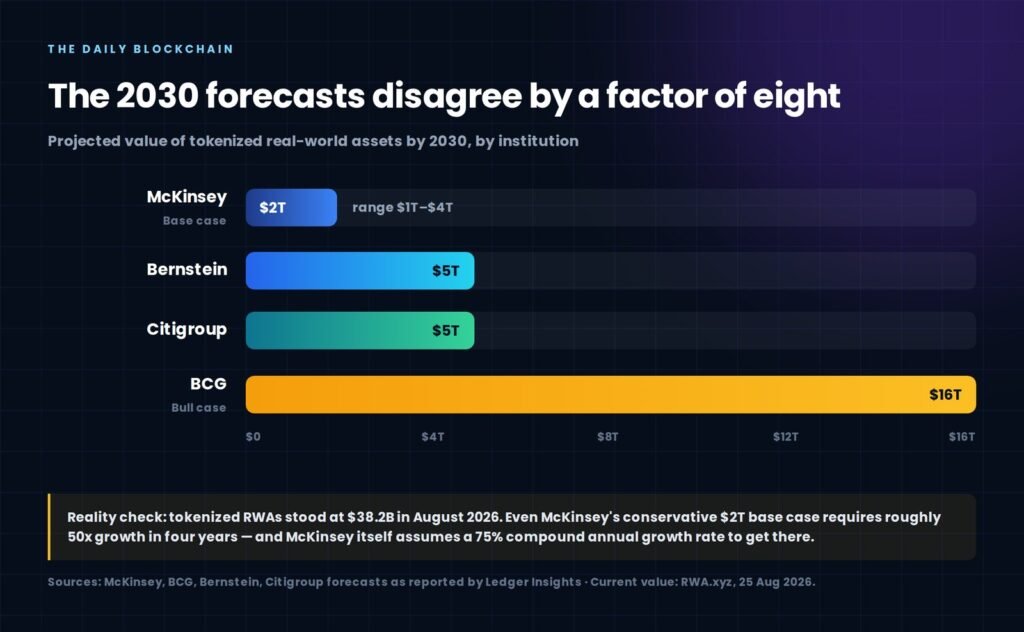
Forecasts for the tokenized asset market by 2030 vary by a factor of eight. McKinsey puts it under $2 trillion, with a range of $1–4 trillion, derived from a 75% compound annual growth assumption. Bernstein and Citigroup land near $5 trillion. BCG’s widely quoted number is $16 trillion.
All of them are forecasting from a base of $38.2 billion. Even McKinsey’s conservative case implies roughly 50x growth in four years. Treat every one of these numbers as a scenario, not a prediction.
Three things worth watching through 2027: whether Nasdaq hits its H1 2027 operational target, whether DTCC’s digital cash settlement work removes the T+1 bottleneck, and whether regulators close or formalise the offshore wrapper gap. The unresolved question underneath all of it, as Sentora’s research puts it, is whether holders can productively use these tokens as collateral for borrowing, hedging or yield — because that, rather than 24-hour trading, is what would make a tokenized share genuinely more useful than the share itself.
Frequently asked questions about tokenized stocks
Are tokenized stocks legal?
It depends on the product and your jurisdiction. Nasdaq’s tokenized securities were approved by the SEC on 19 March 2026 and are fully legal in the US. The offshore wrapper products such as xStocks are restricted to non-US clients and are not registered for US retail sale.
Do tokenized stocks pay dividends?
In the 1:1 wrapper model, dividends are usually passed through economically, net of withholding tax, but you have no legal entitlement to them. In issuer-led native issuance, dividend rights attach directly. Synthetic products pay nothing.
Can US investors buy tokenized stocks?
Not the offshore wrapper products, which exclude US clients. US investors will get regulated access via Nasdaq’s tokenized Russell 1000 shares and ETFs, which the exchange is targeting for operational readiness in the first half of 2027.
Are tokenized stocks safe?
They carry every risk of the underlying equity plus issuer risk, custodian risk, smart contract risk, thin off-hours liquidity and limited investor protection. Nasdaq-route tokenized shares carry the same rights and protections as conventional shares; wrapper tokens do not.
How are tokenized stocks different from a stablecoin?
A stablecoin tracks a currency and aims for a fixed value; a tokenized stock tracks an equity price and moves with the market. Both are backed-asset tokens, but stablecoins are a $302 billion market and tokenized stocks are a $2.5 billion one. You can read more in our guide to the rise of stablecoins.
Which blockchains support tokenized stocks?
Solana, Ethereum and TON host most tokenized equity liquidity today. Ethereum leads the wider real-world asset market with roughly $17.3 billion across 2,090 RWA tokens as of August 2026.
What is the difference between tokenized stocks and a security token offering?
A security token offering issues a new security on-chain to raise capital. Tokenized stocks represent shares in companies that are already publicly listed and trading on conventional exchanges. Our explainer on ICOs and STOs covers the distinction in more depth.
How we researched this
Every figure in this article is dated and attributed. Market size data comes from RWA.xyz’s live dashboard, read on 25 August 2026, and from CoinGecko’s RWA Report 2026 covering the quarter ending 31 March 2026. Note that these two sources define the market differently — RWA.xyz separates stablecoins and counts private credit and corporate bonds, so its total is higher than CoinGecko’s Q1 figure. We have labelled which source each number comes from rather than blending them.
Regulatory detail is drawn from SEC filings and rule approvals as reported by Ledger Insights, and from Skadden’s analysis of the proposed Regulation Crypto Assets. Product mechanics come from Sentora’s research on tokenized stock issuance and settlement, and from Kraken’s own public xStocks disclosures. Where estimates conflict — as with tokenized equities’ share of the RWA market — we have used the figure that reconciles with the underlying dollar values and said so.
Last updated 25 August 2026 by the editorial team at The Daily Blockchain, which has covered blockchain infrastructure and digital asset markets since 2024.
Disclaimer: This article is for information only and is not investment, legal or tax advice. Tokenized stocks carry risk of total loss and offer materially weaker investor protections than conventional share ownership in most current structures. Verify the legal terms of any specific product before buying, and speak to a qualified adviser about your own circumstances.
Sources
- RWA.xyz — Analytics on Tokenized Real-World Assets (accessed 25 August 2026)
- CoinGecko — RWA Report 2026
- Ledger Insights — SEC approves Nasdaq tokenized trading
- Skadden — SEC’s Regulation Crypto Assets
- Sentora Research — How Tokenized Stocks Work
- CryptoSlate — $25B traded in stock tokens that confer no shareholder rights
- TipRanks — World Federation of Exchanges calls for tokenized stock scrutiny
- Ledger Insights — McKinsey tokenization forecast