
Last updated: October 10, 2026
ChatGPT crypto trading works best when you treat the chatbot as a research assistant, not a fortune teller. ChatGPT can summarize a whitepaper in seconds, explain an indicator, stress-test your trade plan and keep your journal honest. It cannot see future prices, it can get numbers wrong, and it should never touch your private keys.
“Any useful AI tools for crypto?” is a question that pops up constantly on Reddit, and AI chat assistants are usually near the top of the answers. The difference between people who find them useful and people who get burned comes down to how they ask. Below you’ll find what ChatGPT can and can’t do, a simple prompt framework, and 15 copy-and-paste prompts you can adapt today. The same prompts work in Claude, Gemini and other assistants, so you can apply this ChatGPT crypto trading playbook whichever tool you prefer.
Key takeaways
- Use ChatGPT for research, explanation, planning and review, not for price predictions or blind trade signals.
- Always ask for sources and verify numbers, especially prices, supply figures and dates.
- In a 2025 real-money AI trading contest, GPT-5 finished last with a loss of about 63%, a reminder not to hand over the wheel.
- Never paste seed phrases, private keys or API secrets into any chatbot.
- OpenAI has no cryptocurrency. “ChatGPT coins” and “ChatGPT trading bots” sold online are not affiliated with OpenAI.
What ChatGPT can and can’t do for crypto trading
| ChatGPT can | ChatGPT can’t |
|---|---|
| Summarize whitepapers, docs and news | Know future prices |
| Explain indicators, order types and DeFi concepts | Guarantee its numbers are correct |
| Build scenarios and checklists | Replace your judgment or a licensed adviser |
| Review your trade journal for patterns | Safely hold keys or move funds for you |
| Do position-size and risk math | Account for news it hasn’t seen |
With web search turned on, ChatGPT can pull recent articles and data, but it can still misread a chart or mix up two tokens with similar names. Treat every figure as a lead to verify, not a fact.
Why not let ChatGPT trade for you?
In October 2025, AI research firm Nof1 gave six AI models $10,000 each to trade crypto futures with real money in a contest called Alpha Arena. When the first season ended, OpenAI’s GPT-5 was down about 62.7%, while Alibaba’s Qwen3-Max was up about 22.3%. A two-week contest proves little, but it shows how quickly an AI with trading authority can lose money. We cover the wider evidence in can AI predict crypto prices?
The 5-part prompt framework for ChatGPT crypto trading
Vague questions get vague answers. “Is SOL a good buy?” invites a generic response. Structure your prompts with five parts instead:
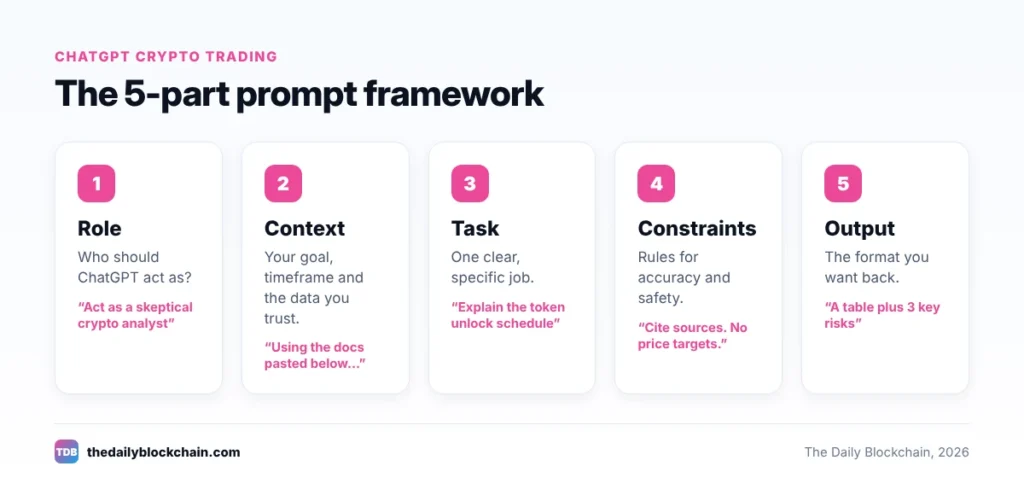
- Role: tell ChatGPT who to act as, such as a skeptical crypto analyst or a risk manager.
- Context: share the relevant facts, like your time horizon, risk tolerance and the data you’re working from.
- Task: ask for one specific job.
- Constraints: set rules, such as “cite sources,” “flag uncertainty” or “no price predictions.”
- Output: specify the format, such as a table, a checklist or a 150-word summary.
Paste your own data where you can, for example a token’s official documentation or your exported trade history with personal details removed. That keeps answers grounded in real information.
15 ChatGPT crypto trading prompts you can copy
These prompts cover the jobs where ChatGPT crypto trading support is genuinely useful. Replace anything in square brackets with your own details.
Research prompts
1. Whitepaper summarizer
“Act as a skeptical crypto research analyst. Summarize the attached whitepaper for [project]. Cover: the problem it solves, how the token is used, who the competitors are, and the three biggest risks. Quote the document when you make a claim, and say clearly if something isn’t covered.”
2. Tokenomics breakdown
“Using the official documentation I’ve pasted below, explain the tokenomics of [token]: total and circulating supply, inflation or emissions, unlock schedule, and allocation to team and investors. Present it as a table and highlight any upcoming unlocks larger than 2% of circulating supply.”
3. Red-flag scan
“Review this project’s website text and social posts for scam or low-quality red flags: guaranteed returns, anonymous team, copied content, unrealistic partnerships, or pressure tactics. Rate each red flag as low, medium or high concern and explain why.”
4. Competitor comparison
“Compare [project A] and [project B] on use case, active users or usage metrics, revenue or fees, token value capture and main risks. Use a table. If you’re unsure of a number, write ‘verify’ instead of guessing.”
5. Explain it like I’m new
“Explain [concept, such as funding rates, impermanent loss or a token unlock] in plain English for someone who has bought crypto but never traded it actively. Use one example with numbers, then list two common mistakes beginners make.”
Market analysis prompts
6. News digest with sources
“Search for the most important news about [token] from the past seven days. Summarize the five most relevant items in one sentence each, with the source and date. Then tell me which items are likely already priced in and which could still matter, and explain your reasoning.”
7. Bull, base and bear scenarios
“Build three scenarios for [token] over the next six months: bull, base and bear. For each, describe what would have to happen, the warning signs that the scenario is playing out, and what I would do differently. Do not give price targets or probabilities you can’t justify.”
8. Indicator explainer for my chart
“I’m looking at a [timeframe] chart of [pair]. RSI is [value], the 50-day moving average is [above/below] the 200-day, and volume is [rising/falling]. Explain what each signal usually suggests, how traders commonly misread it, and what would invalidate the signal.”
Risk management prompts
9. Position size calculator
“My account is $[amount]. I’m willing to risk [1]% per trade. I want to buy [token] at $[entry] with a stop-loss at $[stop]. Calculate the position size, the dollar risk and the reward-to-risk ratio if my target is $[target]. Show the math step by step.”
10. Stop-loss and exit plan
“Help me write an exit plan for this trade: [describe trade]. Include where I’m wrong, where I take partial profits, what news would make me exit early, and what I’ll do if the price gaps through my stop.”
11. Portfolio concentration check
“Here are my holdings and percentages: [list]. Identify concentration risks, such as too much in one sector or highly correlated assets, and suggest questions I should ask myself before adding more. Don’t tell me what to buy.”
Discipline and review prompts
12. Pre-trade checklist
“Create a 10-point pre-trade checklist for a swing trader in crypto with a $[amount] account. Include questions about thesis, risk, liquidity, upcoming events, emotional state and fees.”
13. Trade journal review
“Below is my trade journal for the past month, with entry, exit, size, reason and outcome. Find patterns in my winners and losers: time of day, holding period, position size, and whether I followed my rules. Give me three specific changes to test next month.”
14. Bias detector
“Here’s my reasoning for buying [token]: [paste reasoning]. Act as a devil’s advocate. Point out confirmation bias, FOMO, sunk-cost thinking or overconfidence, and list the evidence that would prove me wrong.”
Records and taxes prompt
15. Tax-record organizer
“I’m a [US/UK/Canadian/Australian] taxpayer. Explain which of these crypto activities are typically taxable events in my country: buying with fiat, swapping tokens, staking rewards, selling for fiat, and moving between my own wallets. Then give me a checklist of records to keep. Remind me to confirm with a tax professional.”
Never upload documents containing your full name, address, account numbers or tax IDs. Remove personal details before sharing any file.
7 common ChatGPT crypto trading mistakes
Most problems with ChatGPT crypto trading come from how the tool is used, not from the tool itself. Avoid these:
- Asking for price predictions. You’ll get a confident-sounding number with no real basis.
- Trusting stale data. Without web search, the model may rely on outdated training data and miss recent unlocks, hacks or listings.
- Mixing up tokens. Many coins share similar names or tickers. Always confirm the contract address and project website.
- Accepting the first answer. Ask follow-up questions like “what would make this wrong?” or “what are you unsure about?”
- Skipping the math check. Re-run position-size and profit calculations yourself or in a spreadsheet.
- Over-sharing personal data. Strip names, addresses and account numbers from anything you upload.
- Letting it override your plan. If ChatGPT’s view conflicts with your written rules, your rules win until you’ve done more research.
A good habit is to end every research session by asking ChatGPT to list the claims you should verify before acting. That turns ChatGPT crypto trading research into a checklist rather than a set of conclusions.
Safety rules for using ChatGPT with crypto
- Never share secrets. No chatbot needs your seed phrase, private key, exchange password or API secret. Anyone asking for them is a scammer.
- Verify every number. Cross-check prices, supply and dates against official sources or a reputable data site.
- Beware fake “ChatGPT” products. OpenAI has no token and doesn’t sell trading bots. Our guide to AI crypto scams shows how fraudsters use AI branding.
- Don’t connect unknown plugins or agents to your wallet. If you experiment with AI agents that can transact, use a separate wallet with a small balance.
- Avoid leverage on AI-generated ideas. A confident answer isn’t a correct one.
ChatGPT vs. other AI tools for crypto
ChatGPT crypto trading research isn’t the only option. Claude is strong at reading long documents, Gemini integrates with Google’s ecosystem, and Perplexity focuses on cited web answers. Many traders use more than one and compare responses, which is a good way to catch errors. Specialized crypto tools add on-chain data and wallet labels that general chatbots lack. For automation, see our guide to the AI crypto trading bot landscape, and remember that any tool with access to your funds needs strict permissions.
Frequently asked questions
Can ChatGPT predict crypto prices?
No. ChatGPT can explain trends and build scenarios, but it has no special knowledge of future prices. In a 2025 real-money contest, GPT-5 lost about 63% trading crypto.
Is there a ChatGPT crypto coin?
No. OpenAI has not launched a cryptocurrency. Tokens using the ChatGPT or OpenAI name are unofficial and often scams.
Can ChatGPT trade crypto for me?
ChatGPT itself doesn’t execute trades on exchanges. Some third-party tools connect AI models to trading accounts, but that adds security and performance risk. Never give any tool withdrawal access.
Is it legal to use ChatGPT for crypto trading?
Using an AI assistant for research is legal in the US, UK, Canada and Australia. You remain responsible for your trades, your taxes and following your exchange’s terms of service.
What is the best prompt for ChatGPT crypto trading?
The best prompts are specific and grounded in real data. Give ChatGPT a role, context, one task, clear constraints like “cite sources,” and an output format.
Sources and further reading
- Alibaba’s Qwen wins AI crypto trading contest (South China Morning Post)
- CFTC customer advisory on AI trading bots
- IRS guidance on digital assets
Disclaimer
This article is for education only and is not financial, investment or tax advice. AI tools can be wrong. Verify information independently and never invest more than you can afford to lose.