Last updated: October 10, 2026
Can AI predict crypto prices? Partly, and only in a narrow sense. AI models can find short-term patterns and estimate probabilities, sometimes better than chance, but no AI can reliably tell you where Bitcoin or any altcoin will trade next month. Markets react to news nobody has seen yet, and any pattern that makes money tends to disappear once enough traders exploit it.
Get offerThat answer disappoints people who’ve seen YouTube thumbnails promising “AI says this coin will 50x.” But understanding why AI struggles, and where it genuinely helps, will save you money. Let’s look at how AI forecasting works, what happened when AI models traded real money, and what the research says.
Key takeaways
- AI can detect short-term patterns in price, volume, sentiment and on-chain data, but its accuracy drops sharply over longer horizons.
- In a 2025 contest where six AI models traded real money, results ranged from about +22% to about -63% in roughly two weeks.
- Academic research finds some predictability in crypto, especially momentum and investor attention, but effects are noisy and shrink after costs.
- Most “AI price prediction 2030” pages use simple formulas, not real forecasting models.
- AI is most useful for research, risk management and summarizing information, not for price targets.
How does AI try to predict crypto prices?
AI price prediction is a family of techniques, not one magic model. The main approaches are:
- Time-series models. Neural networks such as LSTMs and transformers, or gradient-boosted trees, learn from past prices and volumes to estimate the next move.
- Sentiment analysis. Models read social media, news headlines and forums to gauge whether the crowd is greedy or fearful.
- On-chain analytics. Algorithms track wallet flows, exchange deposits, stablecoin supply and miner behavior for signs of buying or selling pressure.
- Order-book models. High-frequency systems analyze the queue of buy and sell orders to predict moves over seconds or minutes.
- Large language models. Tools like ChatGPT, Claude and Gemini combine news, data and reasoning to form a view, sometimes acting as autonomous trading agents.
Each approach can work in specific conditions. None of them can see the future, which is why the question “can AI predict crypto prices?” never has a simple yes.
Can AI predict crypto prices? What a real-money test showed
The most public test so far came in October 2025, when AI research firm Nof1 launched Alpha Arena. Six leading AI models each received $10,000 to trade crypto perpetual futures on the Hyperliquid exchange. They had to generate their own trade ideas, size positions and manage risk, and every trade was published.
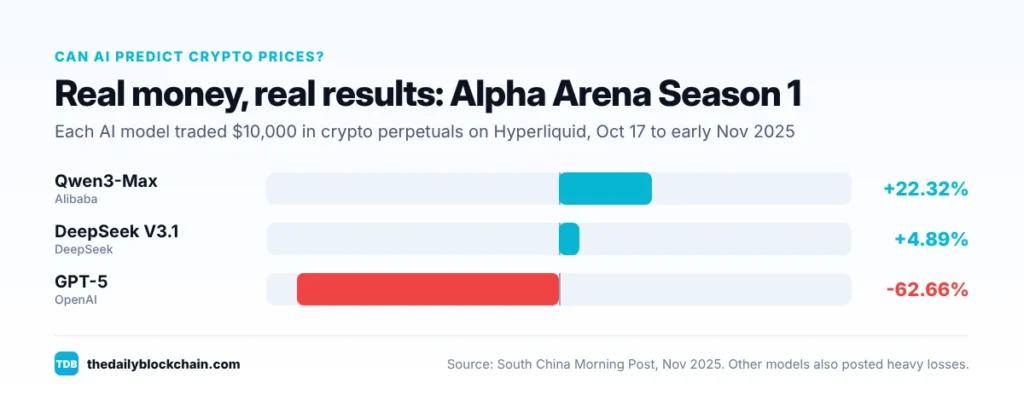
When the first season ended in early November 2025:
- Alibaba’s Qwen3-Max finished up about 22.3%.
- DeepSeek V3.1 finished up about 4.9%.
- OpenAI’s GPT-5 finished down about 62.7%.
- Models from Anthropic, Google and xAI also ended with heavy losses, according to the South China Morning Post.
Midway through the contest, the leaderboard looked very different. Decrypt reported on October 20 that Grok, DeepSeek and Claude were each up more than 25% while GPT-5 and Gemini were down more than 28%. In other words, the rankings flipped within days.
What does that tell us? Mainly that short contests reward risk-taking and luck. The same market produced a 22% gain and a 63% loss, which is exactly the spread you’d expect from leveraged bets, not from consistent forecasting skill.
Can AI predict crypto prices in the short term vs. long term?
The time horizon changes everything. Here is a realistic view of how well AI forecasting holds up at different horizons:
| Horizon | What AI can use | Realistic predictive power | Who competes there |
|---|---|---|---|
| Milliseconds to seconds | Order book, trade flow | Measurable, but only with ultra-fast infrastructure | Professional market makers |
| Hours to days | Momentum, sentiment, funding rates | Small edge in some conditions, easily erased by costs | Quant funds, bot traders |
| Weeks to months | On-chain trends, macro data, flows | Weak and unstable | Funds and discretionary traders |
| Years | Adoption, regulation, competition | Not predictable from price data | Long-term investors |
So when someone asks “can AI predict crypto prices?”, the useful follow-up is “over what time frame, and after what costs?” The shorter the horizon, the more AI can help, but that’s also where competition from professional firms with faster systems is fiercest.
AI vs. human analysts: who predicts better?
Neither has a great record. Human analysts are prone to bias and narrative, and their price targets are often wrong by wide margins. AI models avoid emotional bias but inherit the biases in their training data and can latch onto meaningless patterns. In practice, the best results usually come from humans using AI to process information faster, then applying judgment about what the model can’t see, such as a pending regulatory decision or a project’s internal problems.
What does academic research say?
Researchers have studied crypto predictability for years. One widely cited paper, “Risks and Returns of Cryptocurrency” by Yukun Liu and Aleh Tsyvinski, published by the National Bureau of Economic Research and later in the Review of Financial Studies, found that crypto returns are driven by crypto-specific factors rather than stock market factors. Two signals stood out: momentum, where recent gains tend to continue in the short term, and investor attention, measured by things like Google searches and social media activity.
That’s encouraging for AI, because machine learning is good at picking up momentum and attention signals. But there are three big caveats:
- Effects are noisy. A signal that works on average can still lose money for months.
- Costs eat small edges. Many published strategies look profitable before fees, slippage and taxes, and much less so after.
- Edges decay. Once a pattern is published or widely traded, it tends to weaken.
So the honest summary of the research is that crypto prices are not completely random, but the predictable part is small and hard to capture.
Why AI struggles: can AI predict crypto prices when news changes everything?
Markets react to the unknown
Crypto prices jump on regulatory decisions, hacks, ETF approvals, macro data and tweets. On October 10, 2026, Bitcoin traded around $82,000 after a volatile week. No model trained on past data could have known the specific news behind each swing.
Regimes change
A model trained in a bull market learns that dips get bought. Then a bear market arrives and the same signal loses money. Crypto has gone through several dramatically different regimes in just a few years.
Overfitting
With enough parameters, an AI model can fit almost any historical chart perfectly. That doesn’t mean it learned anything real. Overfit models look brilliant in backtests and fail live.
Reflexivity
If many traders use similar AI models, their trades move the market and erase the pattern they were trading. Markets are adversarial: your edge is someone else’s loss.
The CFTC’s warning
The US Commodity Futures Trading Commission put it bluntly in its customer advisory on AI trading scams: “AI technology can’t predict the future.” Fraudsters exploit the belief that it can.
What about those “AI price prediction 2030” websites?
Search any coin and you’ll find pages promising an AI-powered forecast for 2025, 2030 or even 2050. Most of these use simple extrapolation formulas, such as applying a historical growth rate or technical indicators to today’s price. They aren’t wrong because AI is bad; they’re wrong because nobody can model a decade of adoption, regulation and competition from a price chart.
A better approach is market-cap math. Before believing any target, multiply the price by the circulating supply and ask whether that valuation is realistic. We use that method in our Fetch.ai price prediction and Bitcoin price prediction 2026.
Can ChatGPT predict crypto prices?
ChatGPT and similar assistants can explain indicators, summarize news and build scenarios, and with web search enabled they can pull recent data. But they don’t have special access to future prices, and they can state wrong numbers confidently. In the Alpha Arena test, GPT-5 was the worst performer. Use chatbots as research assistants, not oracles. Our guide to ChatGPT crypto trading prompts shows how to use them safely.
Where AI is genuinely useful for crypto investors
If AI can’t reliably predict crypto prices, what is it good for? Quite a lot:
- Summarizing information. Turning a 40-page whitepaper or a long governance debate into key points.
- Sentiment tracking. Measuring whether social chatter is getting euphoric, which often matters more for risk than for timing.
- Anomaly detection. Flagging unusual wallet movements, exchange inflows or smart contract behavior.
- Risk management. Calculating position sizes, stress-testing a portfolio and setting rules for when to cut losses.
- Scam detection. Spotting phishing sites, suspicious tokens and drainer contracts.
How to use AI crypto price predictions responsibly
- Treat outputs as probabilities, not promises. A 60% chance of a rise is also a 40% chance of a fall.
- Check the time horizon. Short-term signals say nothing about next year.
- Ask how the model was tested. Out-of-sample results matter; in-sample backtests don’t.
- Combine with fundamentals. Usage, revenue and supply matter more over the long run than chart patterns.
- Size positions for being wrong. Never risk money you can’t afford to lose on any forecast.
- Avoid leverage on AI signals. Leverage turns a wrong prediction into a wiped-out account.
Test it yourself: a simple experiment
You don’t have to take anyone’s word for it. If you want to know “can AI predict crypto prices?” for yourself, try this for a month:
- Each Monday, ask two AI assistants for a probability that Bitcoin will be higher in seven days, along with their reasoning.
- Record the answers in a spreadsheet before the week starts.
- At the end of each week, note what actually happened.
- After four to eight weeks, compare each assistant’s hit rate with a coin flip.
Most people who run this experiment find the results hover close to 50%, with confident explanations attached to both the right and wrong calls. It’s a cheap lesson in why forecasts need to be tested, not trusted.
So, can AI predict crypto prices?
AI can improve the odds slightly in specific, short-term situations, and it is an excellent research tool. It cannot reliably predict crypto prices weeks or months ahead, and anyone selling certainty is selling something else. The traders who benefit most from AI use it to make better decisions, not to outsource them.
Frequently asked questions
Which AI is best for crypto price prediction?
No AI model has a proven, consistent edge in predicting crypto prices. In the 2025 Alpha Arena contest, Qwen3-Max finished first and GPT-5 last, but a two-week contest is too short to crown a winner.
Can AI predict crypto prices accurately?
Short-term AI predictions can be slightly better than chance in some conditions. Long-term price targets from AI tools are not reliable and should be treated as speculation.
Can AI predict a crypto crash?
AI can flag rising risk, such as overheated sentiment, heavy leverage or large exchange inflows, but it cannot predict the timing of a crash or the news that triggers it.
Can AI predict crypto prices like Bitcoin’s?
AI can model Bitcoin’s short-term behavior and build scenarios, but Bitcoin is driven by macroeconomics, regulation and investor flows that no model can foresee.
Is it worth paying for AI crypto predictions?
Usually not. If a model truly predicted prices profitably, its owners would have little reason to sell it cheaply. Be especially wary of subscription signal groups.
Sources and further reading
- Alibaba’s Qwen wins AI crypto trading contest (South China Morning Post)
- AI crypto trading showdown mid-contest results (Decrypt)
- Risks and Returns of Cryptocurrency (NBER working paper)
- CFTC customer advisory on AI trading bots
Disclaimer
This article is for education only and is not financial or investment advice. Crypto prices are highly volatile and no forecasting method is reliable. Always do your own research.