
Last updated: October 10, 2026
Decentralized AI crypto refers to blockchain networks that try to make artificial intelligence open and shared rather than controlled by a few large companies. They use tokens to pay for and reward contributions of computing power, data, models and AI agents. Some of these networks are doing real work today. Others are mostly a ticker symbol attached to a buzzword.
On Reddit, two questions about this sector keep coming up: “What’s your opinion on decentralized AI?” and “Is there any AI crypto with a real use case?” Both deserve better answers than “to the moon” or “it’s all a scam.” This guide walks through six use cases, shows which projects are building them, and scores each on how much evidence of real-world use exists in 2026.
Key takeaways
- Decentralized AI crypto aims to open up the key ingredients of AI: compute, models, data, agents and identity.
- The strongest use cases today are GPU marketplaces and AI agents that hold wallets and make payments.
- Even leading projects often lack independently verified revenue, and many tokens are labeled “AI” without doing any AI work.
- Grayscale’s AI crypto sector rose about 54% in September 2026, but is still only around $15B in total.
- Judge projects by usage you can verify, not by partnerships and roadmaps.
Why decentralized AI matters
Training and running frontier AI models requires enormous amounts of specialized hardware, energy and data. Today, a small number of companies control most of it. That creates real concerns:
- Concentration of power. A few firms decide who gets access to the best models and on what terms.
- Censorship and gatekeeping. Centralized providers can change rules, prices or availability overnight.
- Privacy. Sending sensitive data to someone else’s model is a non-starter for many businesses.
- Ownership. People who contribute data or computing power rarely share in the value created.
Decentralized AI crypto projects argue that open networks, coordinated by tokens, can address some of these problems. Whether they can do it at a competitive cost and quality is the open question.
Decentralized AI vs. centralized AI
| Factor | Centralized AI (Big Tech) | Decentralized AI crypto |
|---|---|---|
| Model quality | Frontier models, huge budgets | Mostly open-source and smaller models |
| Cost | Premium pricing, volume discounts | Often cheaper for spare compute |
| Reliability | Strong service guarantees | Varies by provider and network |
| Access rules | Set by one company | Open to anyone who pays or contributes |
| Privacy | Depends on provider policies | Some networks offer confidential computing |
| Ownership of value | Shareholders | Token holders and contributors |
The table shows why decentralized AI crypto is unlikely to replace Big Tech outright. Its realistic path is to win specific jobs where openness, price or privacy matter more than having the single best model.
The decentralized AI crypto stack
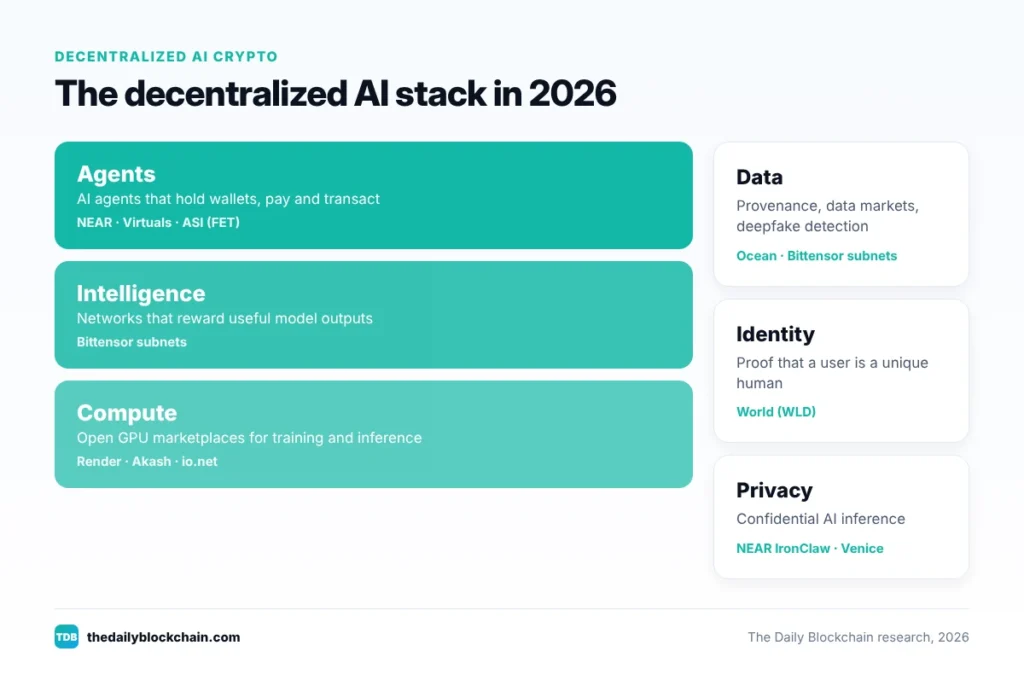
It helps to think of the sector as layers. Compute sits at the bottom, then models and intelligence, then agents that use those models, with data and identity running alongside. Most projects focus on one layer.
Use case 1: GPU and compute marketplaces
What it is: Networks that let anyone rent out spare GPUs and let AI developers buy computing power from a global pool.
Who’s building it: Render (RENDER) began with 3D rendering and expanded into AI compute; its dashboard showed about 81.8 million frames rendered by early October 2026. Akash Network (AKT) and io.net run open cloud marketplaces for GPUs.
Evidence: Strong compared with most of the sector. These networks have paying customers and public usage dashboards, and their pricing is often quoted well below big-cloud on-demand rates.
Weak spots: Reliability, compliance and support still favor large cloud providers for enterprise customers. Token emissions can subsidize prices, so check whether demand would survive without incentives.
Use case 2: Open model marketplaces and incentivized training
What it is: Networks that reward people for producing useful AI outputs, from answering prompts to training models collaboratively.
Who’s building it: Bittensor (TAO) is the leader, with more than 120 specialized subnets competing for rewards. Read our Bittensor TAO explainer for the details.
Evidence: Lots of activity and growing institutional interest, including Grayscale’s Bittensor Trust and ETF filings. But an October 2026 analysis noted that Bittensor still lacks independent evidence of commercial revenue.
Weak spots: Subnets must constantly fight miners who game scoring rules, and emissions-funded activity isn’t the same as customer demand.
Use case 3: AI agents with crypto wallets
What it is: Autonomous AI agents that can hold funds, pay for services and execute transactions on behalf of users or businesses.
Who’s building it: NEAR Protocol has rebuilt around AI agents; its Intents system has handled more than 25 million swaps worth around $20 billion since early 2025. Virtuals Protocol (VIRTUAL) began an invite-only iOS app test in October 2026 that lets personal AI agents hold a wallet and trade within user-set limits. The Artificial Superintelligence Alliance (FET) builds agent frameworks and marketplaces.
Evidence: Growing quickly. Machine-to-machine payments are one of the clearest reasons for AI to use crypto, because agents can’t open bank accounts. Our deep dive on AI agents paying with crypto covers this trend, and our AI agents guide explains the technology.
Weak spots: Security. An agent with a wallet is an attractive target, and mistakes are irreversible on-chain.
Use case 4: Private and confidential AI
What it is: Running AI models on sensitive data without exposing that data to the model provider, using techniques such as trusted execution environments.
Who’s building it: NEAR’s IronClaw framework focuses on confidential inference for business workflows. Venice, whose VVV token rose about 70% in September 2026 according to Grayscale, offers privacy-focused AI access.
Evidence: Early but promising. Privacy is a real pain point for law firms, healthcare providers and finance companies.
Weak spots: Big Tech also offers private AI options, so decentralized versions must compete on trust, price and convenience.
Use case 5: Proof of personhood
What it is: Proving that an online account belongs to a unique human, which matters more as AI-generated bots flood the internet.
Who’s building it: World (WLD), co-founded by Sam Altman, issues IDs verified by its iris-scanning Orb.
Evidence: Millions of sign-ups worldwide, but regulators in several countries have questioned its biometric data practices.
Weak spots: Privacy and regulation. This use case may end up being shaped as much by data-protection law as by technology.
Use case 6: Data provenance and deepfake detection
What it is: Tracking where data and media came from, rewarding people for sharing data, and detecting AI-generated fakes.
Who’s building it: Ocean Protocol built data marketplaces before leaving the ASI Alliance in October 2025. Several Bittensor subnets focus on deepfake detection.
Evidence: Real need, mixed adoption. Deepfake fraud is rising fast; Chainalysis reported that impersonation scams grew about 1,400% in 2025. See our guide to AI crypto scams.
Weak spots: Data marketplaces have struggled to attract both buyers and sellers at scale.
Scorecard: where decentralized AI crypto stands in 2026
| Use case | Example projects | Maturity | Evidence of real demand |
|---|---|---|---|
| GPU and compute marketplaces | Render, Akash, io.net | Live | Strong for the sector |
| Incentivized model networks | Bittensor | Live | Activity high, revenue unproven |
| AI agents with wallets | NEAR, Virtuals, ASI (FET) | Live, early | Growing quickly |
| Confidential AI | NEAR IronClaw, Venice | Early | Promising |
| Proof of personhood | World | Live | Large sign-ups, regulatory risk |
| Data and deepfake detection | Ocean, Bittensor subnets | Early | Mixed |
The hype check: what Reddit skeptics get right
Skeptics raise fair points about decentralized AI crypto:
- “Most AI coins don’t need a token.” Often true. If a product would work just as well with dollar payments, the token may be decoration.
- “Revenue is mostly token emissions.” Many networks pay contributors in newly issued tokens, which can make usage look healthier than it is.
- “Big Tech will win anyway.” Centralized providers have massive scale advantages in hardware, talent and distribution.
- “Category labels mean nothing.” As crypto.news put it in its October 2026 review of the sector, category membership is “not proof of AI revenue.”
Supporters respond that open networks don’t have to beat Big Tech everywhere, only in specific niches such as cheaper spare compute, censorship-resistant access, private inference and agent payments. Both views can be partly right.
What could make decentralized AI crypto succeed?
Several developments over the next few years could separate lasting projects from passing narratives:
- Agent commerce at scale. If millions of AI agents need to pay each other for data, compute and services, crypto rails are a natural fit, and networks like NEAR and Virtuals are positioning for it.
- GPU shortages persisting. Continued scarcity of high-end chips keeps demand high for any marketplace that can unlock idle hardware.
- Regulated access. Exchange-listed products, such as the Bittensor ETPs that Grayscale and Bitwise have filed for in the US, could bring steadier institutional capital.
- Real revenue disclosure. Projects that publish audited or verifiable revenue will earn more trust than those relying on token-funded activity.
- Open-source model progress. The better open models get, the more valuable open infrastructure to train and serve them becomes.
On the other hand, a sharp crypto bear market, a major exploit, or Big Tech cutting prices aggressively could set the sector back years.
How to evaluate a decentralized AI crypto project
- Find the usage data. Look for public dashboards showing compute hours, jobs, swaps or active agents.
- Separate paid demand from subsidies. Ask how much activity is paid in stablecoins or fiat versus rewarded with new tokens.
- Check value capture. Does using the network require, burn or stake the token?
- Read the supply schedule. Large unlocks and high inflation can overwhelm demand.
- Look for outside customers. Named, verifiable users beat vague partnership announcements.
- Assess security. Has the project had exploits, and how did it respond?
Our ranking of the best AI crypto coins of 2026 applies a similar framework.
Frequently asked questions
What is decentralized AI in crypto?
Decentralized AI in crypto means using blockchain networks and tokens to coordinate AI resources, such as computing power, models, data and agents, across many independent participants instead of one company.
Is decentralized AI crypto a good investment?
It’s a high-risk, early-stage sector. A few projects show real usage, but most lack verified revenue and prices are very volatile. Only invest what you can afford to lose.
What are the biggest decentralized AI crypto projects?
By market value in October 2026, major names included NEAR, Bittensor (TAO), Render (RENDER), the Artificial Superintelligence Alliance (FET) and Virtuals Protocol (VIRTUAL).
Can decentralized AI compete with OpenAI and Google?
Not head-to-head on frontier models today. Decentralized AI is more likely to compete in niches like spare GPU capacity, open-source model hosting, private inference and payments between AI agents.
What is DePIN, and how is it related to decentralized AI?
DePIN stands for decentralized physical infrastructure networks, which use tokens to coordinate real-world hardware. GPU compute networks like Render and Akash are both DePIN and decentralized AI projects.
Sources and further reading
- Best AI cryptocurrencies in October 2026: five working theses (crypto.news)
- Grayscale AI crypto sector gains 54% in September (Crypto Briefing)
- Bittensor’s halving and subnet growth (The Block)
- Crypto impersonation scams rise 1,400% (Cointelegraph)
Disclaimer
This article is for education only and is not financial or investment advice. Crypto assets are volatile and many projects fail. Always do your own research.