
Last updated: October 10, 2026
AI crypto scams use artificial intelligence, such as deepfake videos, cloned voices, chatbots and fake “AI trading” platforms, to trick people into sending cryptocurrency. They’re growing fast because AI makes scams cheaper to run, easier to personalize and far more convincing than the broken-English emails of a few years ago.
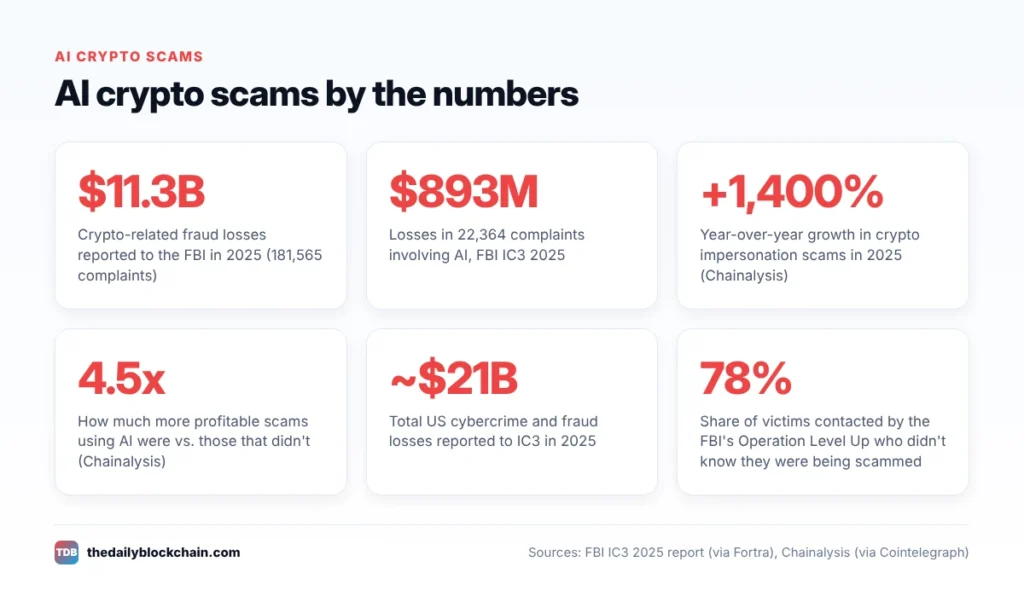
The numbers are sobering. The FBI’s Internet Crime Complaint Center (IC3) recorded more than $11.3 billion in cryptocurrency-related losses in 2025, the highest of any category, and 22,364 complaints involving AI, with losses above $893 million. Blockchain analytics firm Chainalysis found that impersonation scams grew roughly 1,400% year over year in 2025 and that scams using AI were about 4.5 times more profitable than those that didn’t. Here are the seven tricks you’re most likely to meet, and exactly how to shut each one down.
Key takeaways
- Crypto was the costliest fraud category in the FBI’s 2025 report, with more than $11.3 billion in reported losses.
- AI makes scams more convincing through deepfake celebrities, cloned voices of family members and fluent chatbot conversations.
- No legitimate investment, celebrity or company will ever ask you to send crypto to “double” it or unlock a prize.
- Guaranteed returns from an “AI trading bot” are the clearest warning sign of fraud.
- If you’ve been scammed, report it quickly and beware of “recovery” services, which are often a second scam.
Why AI crypto scams are exploding
Scammers have always relied on trust and urgency. AI supercharges both:
- Scale. A single operator can run hundreds of chatbot conversations at once in fluent English.
- Realism. Deepfake video and voice cloning can make a fake celebrity or relative look and sound real.
- Personalization. AI can scrape your social media and tailor a message to your interests, job or family.
- Speed. Fake websites, whitepapers and “AI trading dashboards” can be generated in minutes.
Crypto is the payment method of choice because transfers are fast, global and usually irreversible.
1. Deepfake celebrity giveaways and livestreams
How it works: You see a video, often a hijacked YouTube livestream or a social media ad, of a famous tech founder or crypto figure announcing a giveaway: “Send 0.1 BTC and receive 0.2 BTC back.” The face and voice look real because they’re AI-generated.
Red flags: Any promise to multiply your crypto, comments full of “it worked for me,” a countdown timer, or a QR code to a wallet address.
How to stop it: Remember the rule: nobody gives away money by asking you to send money first. Report the video on the platform and close it.
2. Voice-cloned family or boss emergencies
How it works: You get a call that sounds exactly like your child, parent or manager. They’re in trouble and need money urgently, sometimes in crypto or gift cards. A few seconds of audio from social media is enough to clone a voice.
Red flags: Extreme urgency, secrecy (“don’t tell Mom”), and an unusual payment method.
How to stop it: Hang up and call the person back on a number you already know. Agree on a family code word that a scammer couldn’t guess.
3. Fake AI trading bots and platforms
How it works: Ads promise that an AI trading bot earns 1% to 3% a day automatically. You deposit crypto into the platform, a slick dashboard shows growing profits, and then withdrawals are blocked unless you pay “taxes” or “fees.” The CFTC has highlighted cases like Mirror Trading International, which allegedly took more than $1.7 billion in bitcoin from at least 23,000 people with promises of AI-driven returns.
Red flags: Guaranteed returns, deposits made to the company rather than your own exchange account, and fake celebrity endorsements. Platforms often use names that borrow AI buzzwords.
How to stop it: Real bots connect to your own exchange account with limited permissions. Read our guide to the AI crypto trading bot market to see what legitimate tools look like.
4. AI-powered romance and “pig butchering” scams
How it works: A friendly stranger messages you by “wrong number” or on a dating app. Over weeks, an AI-assisted conversation builds trust, then introduces a “can’t-lose” crypto investment on a fake platform. The FBI says most crypto losses in its 2025 report came from investment fraud of this kind.
Red flags: An attractive stranger who never video calls live, steers the conversation to investing, and shows screenshots of big profits.
How to stop it: Never invest through a platform suggested by someone you’ve only met online. The FBI’s Operation Level Up has contacted thousands of victims, and in 2025 it found that 78% didn’t realize they were being scammed.
5. Exchange and wallet support impersonation
How it works: You receive a call, text or email from “Coinbase security” or “Ledger support” warning that your account is compromised. AI-written scripts and spoofed caller IDs make it convincing. They walk you into moving funds to a “safe wallet” they control or entering your recovery phrase. Chainalysis reported that scammers posing as Coinbase stole nearly $16 million from victims.
Red flags: Unsolicited contact, pressure to act immediately, and any request for your seed phrase or to move funds.
How to stop it: Real support will never ask for your recovery phrase. Hang up and contact the company only through its official app or website.
6. AI-generated phishing sites and wallet drainers
How it works: AI tools clone exchange login pages, DeFi apps and airdrop sites in minutes. Connecting your wallet and signing a malicious transaction lets a “drainer” contract empty it.
Red flags: Links from DMs or ads, slightly misspelled domains, and transactions asking for unlimited token approvals.
How to stop it: Bookmark the sites you use, use a wallet that simulates transactions before you sign, and revoke old token approvals regularly. Our guide on how to keep crypto safe covers wallet hygiene.
7. Fake AI tokens and “AI-washing”
How it works: Promoters launch tokens with names like “ChatGPT Coin” or “OpenAI Token,” or exaggerate the AI in a real product. OpenAI has never issued a cryptocurrency. Regulators have also cracked down on “AI-washing” in traditional finance: in March 2024 the SEC settled charges against two investment advisers for making false claims about their use of AI.
Red flags: Borrowed brand names, no working product, anonymous teams and influencer hype.
How to stop it: Verify any project’s claims and contract address on its official channels. Our explainer on what AI crypto is shows how to separate real projects from imitations.
Your AI crypto scams protection checklist
- Never share your seed phrase or private keys. No legitimate person or company needs them.
- Slow down. Urgency is a scammer’s best tool. Wait 24 hours before any unusual transfer.
- Verify independently. Call back on known numbers and type website addresses yourself.
- Use strong account security. Enable app-based or hardware-key two-factor authentication, not SMS.
- Keep most funds in a wallet you control and only small amounts on exchanges or hot wallets.
- Set a family code word for emergencies.
- Be skeptical of video and voice. Seeing or hearing someone is no longer proof it’s them.
- Check regulators’ warning lists, such as the FCA’s in the UK, before using an unfamiliar platform.
What to do if you’ve been scammed
- Stop sending money immediately, even if the scammer promises a refund after “one last fee.”
- Document everything: wallet addresses, transaction IDs, screenshots, phone numbers and websites.
- Contact your exchange right away; it may be able to freeze funds that haven’t left the platform.
- Report the fraud to the right authority in your country (see the list below).
- Beware recovery scams. People who promise to recover stolen crypto for an upfront fee are almost always scammers themselves.
Where to report AI crypto scams
- United States: the FBI at ic3.gov and the FTC at ReportFraud.ftc.gov.
- United Kingdom: Report Fraud, the City of London Police service that replaced Action Fraud.
- Canada: the Canadian Anti-Fraud Centre.
- Australia: Scamwatch and ReportCyber.
Reporting matters even if you don’t expect to recover funds. Reports help investigators link cases, freeze scam wallets and warn other potential victims.
How AI is also fighting back
The same technology behind AI crypto scams is being used to stop them. Major exchanges use machine-learning models to flag unusual withdrawals and known scam addresses before funds leave the platform. Wallet apps increasingly simulate each transaction and warn you if a signature would hand over your tokens. Blockchain analytics firms trace stolen funds across chains, and some decentralized AI networks run deepfake-detection services. None of these tools is perfect, but turning on every protection your exchange and wallet offer closes many of the easiest attack routes.
Protect the people around you
Many victims of AI crypto scams are not crypto experts at all. Older relatives are frequent targets of impersonation and “investment opportunity” calls, while teenagers and young adults are often reached through games, Discord servers and fake airdrops. Share three simple rules with family and friends: never send crypto to someone you’ve only met online, never share a recovery phrase, and always call back on a known number before acting on an urgent request. A five-minute conversation can prevent a life-changing loss.
How big is the problem, really?
The IC3’s 2025 report showed Americans lost almost $21 billion to cybercrime and fraud, with complaints passing one million for the first time in its 25-year history. Crypto-related losses alone exceeded $11.3 billion across 181,565 complaints. Chainalysis estimated that crypto scam revenue hit a record of about $17 billion in 2025. And because many victims never report, the real figures are likely higher. AI crypto scams are a fast-growing slice of that total, and they’ll keep evolving as AI tools improve.
Frequently asked questions
What are AI crypto scams?
AI crypto scams are frauds that use artificial intelligence, such as deepfake videos, voice cloning, chatbots or fake AI trading platforms, to persuade victims to send cryptocurrency or reveal wallet access.
How can I tell if a crypto video is a deepfake?
Look for unnatural blinking or lip sync, odd lighting, and a voice that sounds slightly flat. More importantly, judge the request: any video asking you to send crypto to receive more back is a scam, real or not.
Are AI crypto trading bots scams?
Not all, but many are. Legitimate bots connect to your own exchange account and never guarantee returns. Platforms that hold your money and promise fixed daily profits are major red flags.
Can I get my crypto back after a scam?
Sometimes, if funds are frozen quickly at an exchange or traced by law enforcement, but recovery is rare. Report immediately and never pay a “recovery service” upfront.
Who is most targeted by AI crypto scams?
Anyone can be targeted. Older adults are frequent victims of impersonation and investment scams, while younger users are often targeted through social media, gaming and fake airdrops.
Sources and further reading
- AI and cryptocurrency scams are costing Americans billions: FBI IC3 report (Fortra)
- Crypto impersonation scams grow 1,400% (Cointelegraph)
- Scammers stole $17 billion in crypto in 2025 (KnowBe4)
- CFTC: AI Won’t Turn Trading Bots into Money Machines
- Report Fraud replaces Action Fraud (GOV.UK)
Disclaimer
This article is for general information and education. If you believe you are a victim of fraud, contact your bank or exchange and your national reporting service immediately.