Last updated: October 10, 2026
What is AI crypto? AI crypto is a group of cryptocurrencies and blockchain projects that either supply resources to artificial intelligence, such as computing power, data and models, or use AI to power crypto products like autonomous agents and trading tools. The token usually pays for those services, rewards the people who provide them, or gives holders a say in how the network is run.
Get offerThat one-sentence answer to what is AI crypto hides a lot of variety. Some AI tokens sit on top of networks with thousands of real GPUs. Others are memecoins with a robot logo. This guide explains how AI crypto works, the four main types, how the tokens are supposed to gain value, and how to tell the difference between substance and marketing.
Key takeaways
- AI crypto covers tokens that pay for AI resources (compute, data, models) or that power AI-driven apps and agents.
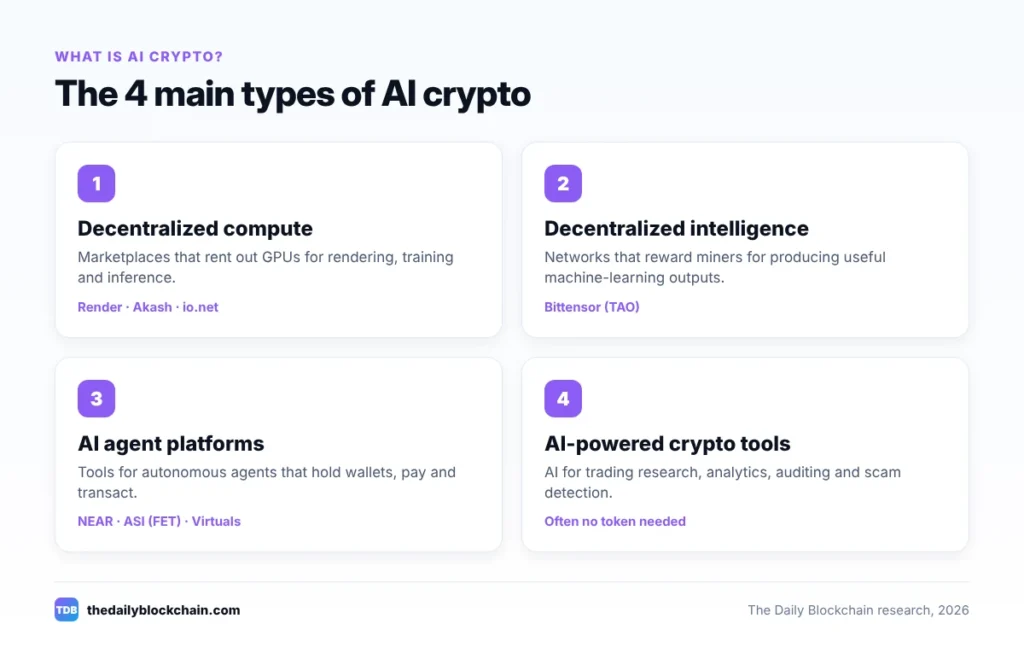
- The four main types are decentralized compute, decentralized intelligence, AI agent platforms and AI-powered crypto tools.
- The category is small: CoinGecko’s broad AI list was worth about $26.2B in early October 2026, and Grayscale’s stricter AI sector about $15B.
- A token being labeled “AI” does not prove the project earns any AI revenue.
- OpenAI, the maker of ChatGPT, has no cryptocurrency. Any “ChatGPT token” is unofficial.
What is AI crypto, in plain English?
If you’re still wondering what is AI crypto in practical terms, start with what AI itself needs. AI depends on three ingredients: computing power to train and run models, data to learn from, and a way to deliver the results to users. Today those ingredients are mostly controlled by a handful of large technology companies.
AI crypto projects try to rebuild some of those ingredients as open marketplaces. Instead of renting GPUs from one cloud provider, you rent them from thousands of independent operators. Instead of one company deciding which model is “best,” a network of validators scores competing models and pays the winners. The cryptocurrency is the payment and reward system that keeps strangers cooperating without a central boss.
The second half of the category runs in the other direction: using AI to make crypto easier. That includes AI agents that hold wallets and trade on your behalf, chat assistants that read blockchains, and analytics tools that flag scams.
Why would AI need a blockchain at all?
It’s a fair question, and skeptics on Reddit ask it constantly. Many AI products don’t need a blockchain. But there are a few places where crypto adds something useful:
- Payments between machines. AI agents can’t open bank accounts, but they can hold a crypto wallet and pay for data or compute in seconds. Our article on AI agents paying with crypto covers this trend in depth.
- Open marketplaces. Tokens let a network reward anyone who contributes GPUs, data or models, anywhere in the world, without contracts.
- Verifiability. Blockchains create a public record of who did what, which helps with proving where data or AI outputs came from.
- Proving you’re human. As AI-generated accounts multiply, crypto-based identity systems try to prove a user is a unique person.
Where these needs are real, AI crypto has a shot at lasting. Where they’re not, the token is often decoration.
The 4 main types of AI crypto
The easiest way to answer what is AI crypto is to look at what each project actually does. Most fall into one of four groups.
1. Decentralized compute networks
These networks connect people who need computing power with people who have spare GPUs. Render (RENDER) started with 3D graphics and expanded into AI workloads; its foundation dashboard showed about 81.8 million frames rendered by early October 2026. Akash Network (AKT) and io.net run open marketplaces for cloud GPUs. Buyers usually pay less than big-cloud on-demand prices, in exchange for less hand-holding.
2. Decentralized intelligence networks
Here the network produces AI outputs, not just raw compute. The best-known example is Bittensor (TAO), where miners compete in specialized “subnets” to deliver useful machine learning, and validators reward the best results with TAO. Bittensor has Bitcoin-style supply rules, including a 21 million cap and a halving that cut daily issuance from 7,200 to 3,600 TAO in December 2025. We explain it fully in our Bittensor TAO guide.
3. AI agent platforms
These projects let developers build autonomous agents that can search, negotiate and transact. Examples include the Artificial Superintelligence Alliance (FET), built around Fetch.ai’s agent framework, Virtuals Protocol (VIRTUAL), which launches and tokenizes agents, and NEAR Protocol, which has repositioned itself as a chain for user-owned AI agents. NEAR’s Intents system has routed more than 25 million swaps since early 2025.
4. AI-powered crypto tools
This group uses AI to improve crypto products: trading assistants, portfolio analytics, smart contract auditing, fraud detection and wallet security. Many of these are regular companies without a token, which is often a good sign. When a simple analytics app insists you buy its token to use it, ask why.
Some projects also sit just outside these four boxes, such as World (WLD), which issues proof-of-personhood IDs, and data marketplaces like Ocean Protocol.
What is AI crypto vs. regular crypto?
When people ask what is AI crypto compared with Bitcoin or Ethereum, the difference is purpose. Bitcoin is designed to be money. Ethereum is a general platform for apps. An AI crypto project is built around a specific AI job, such as renting GPUs, ranking models or running agents, and its token is tied to that job.
That focus cuts both ways. If demand for decentralized AI grows, a specialized token can benefit directly. If it doesn’t, there is little else holding the price up. Bitcoin, by contrast, does not depend on any single use case taking off.
A short history of AI crypto
- 2017-2018: The first wave arrives during the ICO boom. SingularityNET and Fetch.ai raise money to build AI marketplaces and agents.
- 2021: Bittensor launches its network, rewarding machine learning with TAO.
- 2023: ChatGPT’s breakout success triggers a rush into anything labeled AI, including tokens.
- 2024: Fetch.ai, SingularityNET and Ocean Protocol merge their tokens into the Artificial Superintelligence Alliance. FET hits an all-time high near $3.45 in March.
- 2025: AI agents with wallets become the hot narrative. Bittensor launches dynamic TAO and has its first halving in December. Ocean Protocol leaves the ASI Alliance in October.
- 2026: Grayscale and Bitwise file for Bittensor exchange-traded products, and Grayscale tracks AI as its own crypto sector, which jumps about 54% in September.
Seen through that history, the answer to what is AI crypto keeps changing: it started as a promise of AI marketplaces and has become a mix of real infrastructure, agent platforms and plenty of speculation.
How do AI crypto tokens gain value?
Understanding what AI crypto is also means understanding why the token should be worth anything. Look for one or more of these mechanisms:
| Mechanism | How it works | Example |
|---|---|---|
| Payment | You must spend the token to use the service | Paying for rendering or compute |
| Burn | Tokens used for payment are destroyed, reducing supply | Render’s burn-and-mint design |
| Staking | Providers or validators lock tokens as a security deposit | Bittensor validators, NEAR stakers |
| Rewards | New tokens are issued to people who contribute useful work | TAO emissions to miners |
| Governance | Holders vote on upgrades or treasury spending | NEAR inflation proposals |
The strongest designs tie the token directly to demand for the service. The weakest let the product succeed while the token is optional, which means usage can grow while the price goes nowhere.
How big is the AI crypto market?
Another way to answer what is AI crypto is to look at its size: smaller than the headlines suggest. CoinGecko’s broad AI category was worth about $26.2 billion in early October 2026, but that list includes many tokens that simply use the AI label. Grayscale’s stricter AI crypto sector was roughly $15 billion after rising about 54% in September 2026, the smallest of its six crypto sectors.
For perspective, Nvidia alone was valued at around $5.7 trillion in early October 2026. The entire AI crypto category is a rounding error by comparison, which is both the bull case (lots of room to grow) and the bear case (tiny, illiquid and volatile). We compare the two directly in AI stocks vs AI crypto.
AI crypto vs. AI-themed memecoins
A large share of tokens tagged “AI” on price websites are memecoins: they have a mascot, a community and a chart, but no product. Some even borrow famous names. Remember:
- OpenAI has no token. There is no official ChatGPT coin.
- Agent tokens can be memecoins too. Launching a token for an AI chatbot personality doesn’t make it an infrastructure project.
- Memecoins aren’t automatically scams, but they’re pure speculation, and you should size them accordingly.
What are the risks of AI crypto?
- Extreme volatility. FET fell more than 90% from its 2024 high, even though the project kept building.
- Revenue uncertainty. An October 2026 analysis noted that even Bittensor, the sector’s flagship, still lacked independent evidence of commercial revenue.
- Token inflation. Networks that reward contributors with new tokens create constant selling pressure.
- Competition from Big Tech. Hyperscale clouds and AI labs can cut prices or ship features faster than open networks.
- Regulation. Rules for crypto and for AI are both still changing in the US, UK, EU, Canada and Australia.
- Scams. The AI label is a favorite of fraudsters. Read our guide to AI crypto scams before you invest.
A 7-question checklist before buying any AI token
- Can I use the product today, without buying the token?
- Is there public data on usage, such as compute hours, swaps or active agents?
- Does using the network require, burn or stake the token?
- How many new tokens are issued each year, and when are the big unlocks?
- Who are the founders, and how much of the supply do insiders hold?
- Is the token listed on regulated exchanges available in my country?
- What would make this project fail, and how likely is that?
If you can’t answer at least five of these, keep researching or move on. Our best AI crypto coins of 2026 applies a similar framework to seven leading projects.
How do you invest in AI crypto?
Most people buy AI tokens on a centralized exchange. Choose one that is registered with your local regulator, such as a FinCEN-registered and state-licensed platform in the US or an FCA-registered firm in the UK, and compare fees in our best crypto exchanges guide. For long-term holdings, move coins to a wallet you control and store the recovery phrase offline.
Some investors prefer indirect exposure. Grayscale runs a Decentralized AI Fund holding NEAR, TAO, RENDER and FIL, and a Bittensor Trust that trades over the counter. Fees on these products can be high, so read the fund documents first. Remember that crypto gains are taxable in the US, UK, Canada and Australia.
Frequently asked questions
Is there an AI cryptocurrency?
Yes. There are dozens of AI cryptocurrencies. The largest by market cap in October 2026 included NEAR, Bittensor (TAO), Render (RENDER), the Artificial Superintelligence Alliance (FET) and Virtuals Protocol (VIRTUAL).
What is AI crypto used for in real life?
AI crypto is used to pay for decentralized computing power, reward people who provide AI models or data, let AI agents hold wallets and make payments, and prove that online users are human.
Is ChatGPT a cryptocurrency?
No. ChatGPT is an AI chatbot made by OpenAI, and OpenAI has not issued any cryptocurrency. Tokens using the ChatGPT or OpenAI name are not affiliated with the company.
What is AI crypto’s biggest risk?
Volatility and unproven revenue are the biggest risks. No investment in AI crypto is “safe.” The tokens are volatile and many projects are unproven. You can reduce risk by sticking to established projects, buying on regulated exchanges, securing your wallet and investing only what you can afford to lose.
Is AI crypto a good investment for beginners?
Beginners should learn how crypto wallets, exchanges and taxes work before buying small-cap AI tokens. If you do invest, start with a small amount and avoid leverage.
Sources and further reading
- Best AI cryptocurrencies to buy in October 2026 (crypto.news)
- Grayscale AI crypto sector gains 54% in September (Crypto Briefing)
- Bittensor emissions documentation
- Nvidia nears a $6 trillion market cap (Crypto Briefing)
Disclaimer
This article is for education only and is not financial, investment or tax advice. Crypto assets are volatile and you can lose all of your money. Always do your own research.