Last updated: October 10, 2026
Bittensor (TAO) is a decentralized network that pays people in cryptocurrency for producing useful artificial intelligence. Instead of one company training and owning a model, thousands of independent “miners” compete to deliver machine-learning work, “validators” score that work, and the network rewards the best contributors with its native token, TAO.
Get offerBittensor TAO has become the flagship of the AI crypto sector. It has Bitcoin-style supply rules, it completed its first halving in December 2025, and two of Wall Street’s best-known crypto asset managers have filed to bring it to US exchanges. This guide explains how the network works, what changed in 2025 and 2026, how to buy and stake TAO, and the risks that rarely make the headlines.
Key takeaways
- Bittensor is a marketplace for machine intelligence, split into specialized “subnets” for tasks like text generation, compute, storage and deepfake detection.
- TAO has a 21 million supply cap. The first halving on December 14, 2025 cut daily issuance from 7,200 to 3,600 TAO.
- Dynamic TAO, launched in February 2025, gave each subnet its own token and let the market steer rewards.
- Grayscale’s Bittensor Trust (GTAO) trades over the counter, and Grayscale and Bitwise have filed for US exchange-traded products.
- The biggest open question is revenue: analysts still want independent evidence of paying customers.
What is Bittensor?
Bittensor launched in 2021, developed by the Opentensor Foundation, which was co-founded by Jacob Steeves and Ala Shaabana. Its core idea is simple to state and hard to build: create an open market where AI models and services compete, and use a token to reward whoever produces the most valuable results.
Unlike many crypto projects, TAO had no initial coin offering or pre-mine. Every token in circulation was earned by mining or validating, which is one reason long-time supporters compare Bittensor TAO to early Bitcoin.
How Bittensor works: subnets, miners and validators
Subnets
A subnet is a specialized competition inside Bittensor. Each one defines a task and the rules for judging it. There were roughly 128 to 129 active subnets by late 2025, covering areas such as language models, distributed training, GPU compute, data storage, AI agents, prediction and deepfake detection. Anyone can register a new subnet by paying a fee, and subnets compete for a share of the network’s rewards.
Miners
Miners are the workers. They run models or provide resources that perform the subnet’s task, such as answering prompts, training part of a model or supplying compute. Better work earns more rewards.
Validators
Validators are the judges. They send tasks to miners, score the responses and submit weights that determine how rewards are split. Validators must stake TAO, which gives them skin in the game. Bittensor combines these scores using a mechanism called Yuma Consensus, designed to reward validators who agree with the honest majority and penalize outliers.
Stakers
Regular TAO holders can delegate their tokens to validators and earn a share of rewards without running hardware. This is how most retail investors participate.
The TAO token: supply, emissions and the 2025 halving
TAO’s monetary policy deliberately mirrors Bitcoin:
- Maximum supply: 21 million TAO.
- Block time: about 12 seconds.
- Halvings: issuance is cut in half at set supply milestones, roughly every four years.
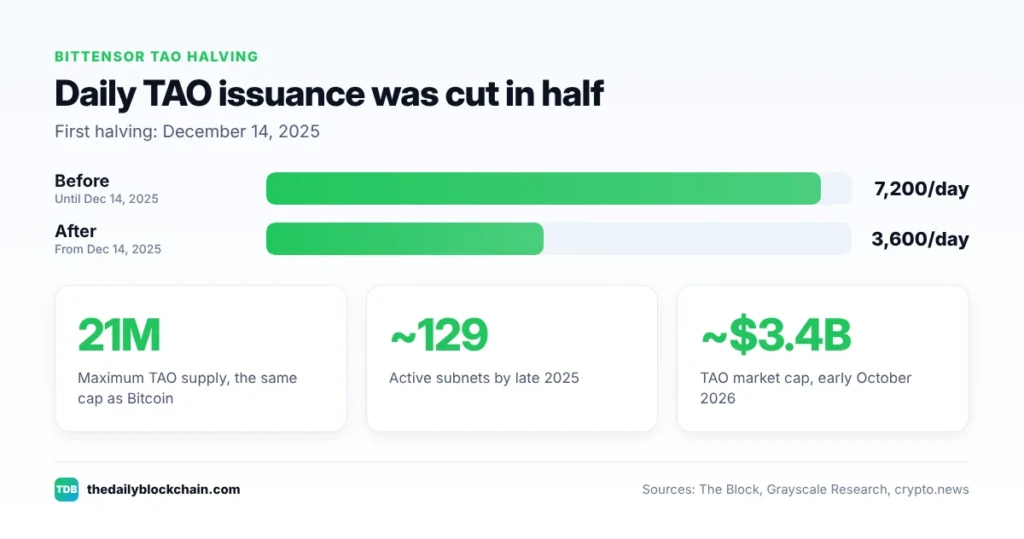
The first halving happened on December 14, 2025, cutting daily issuance from 7,200 TAO to 3,600 TAO. Grayscale published research ahead of the event arguing that reduced supply, growing institutional interest and early subnet success could support the price, drawing parallels with Bitcoin’s halvings. Lower issuance also means less automatic selling from miners who need to cover hardware and electricity costs.
As of early October 2026, Bittensor TAO traded around $300 with a market cap of roughly $3.4 billion, implying about 11 million tokens in circulation. TAO rose about 37% in September 2026 alone, according to Grayscale, but it remains well below its March 2024 peak above $750.
Dynamic TAO: subnets became investable
In February 2025, Bittensor launched dynamic TAO, often shortened to dTAO. Before dTAO, a small group of validators on the “root” network decided how emissions were split between subnets. Afterward, each subnet received its own “alpha” token with a liquidity pool, and TAO holders could stake into specific subnets.
The effect was to let the market vote with capital. Subnets that attract more stake receive more emissions. Grayscale noted that dTAO led to a sharp expansion in the total market value of subnet tokens, and dedicated funds from firms such as Yuma Asset Management now invest in top subnets.
2026 changes
Bittensor kept tinkering in 2026. A May 2026 emissions refactor concentrated rewards in roughly 30 of the most competitive subnets, followed by tooling and validator upgrades over the summer, including a stake-lock mechanism tied to subnet ownership and a validator overhaul linking participation more closely to subnet performance. The direction is clear: fewer, stronger subnets rather than hundreds of lightly used ones.
Bittensor TAO and Wall Street: the ETF filings
Institutional access is one of the biggest stories around Bittensor TAO in 2026:
- Grayscale Bittensor Trust (GTAO) began trading on OTC Markets in December 2025 and became an SEC reporting company.
- Grayscale filed an S-1 to convert the trust into an exchange-traded product listed on NYSE Arca, and filed an amended registration in 2026.
- Bitwise also filed for a spot TAO product, setting up a race for the first US Bittensor ETP.
- Public companies, including TAO Synergies, have set up corporate TAO treasuries.
As of early October 2026, the exchange listing was still pending SEC approval. Check the latest status before trading on ETF headlines, because approval timing is uncertain.
Bittensor vs. other AI crypto projects
| Project | Main focus | How it differs from Bittensor |
|---|---|---|
| Render (RENDER) | GPU rendering and compute | Sells raw compute; Bittensor rewards AI outputs |
| Akash (AKT) | Decentralized cloud marketplace | Rents servers; no competition between models |
| ASI Alliance (FET) | AI agent framework | Builds agents; Bittensor builds a market for intelligence |
| NEAR | Blockchain for AI agents | General smart-contract chain with AI features |
For a broader comparison, see our ranking of the best AI crypto coins of 2026.
How to buy and stake TAO
- Buy TAO on a regulated exchange available in your country. Listings vary between the US, UK, Canada and Australia, so check before you sign up. Our best crypto exchanges 2026 guide can help.
- Withdraw to a Bittensor-compatible wallet if you plan to stake. Use only the official wallet software or a reputable hardware wallet integration.
- Delegate to a validator with a solid track record and reasonable commission, or stake into a specific subnet if you understand the extra risk of alpha tokens.
- Track your rewards for taxes. In the US, staking rewards are generally taxable as income when you receive them, according to IRS guidance.
Some exchanges also offer native TAO staking, which is simpler but means trusting the exchange with your tokens.
The bear case: risks of Bittensor TAO
Every serious investor should understand the arguments against Bittensor TAO:
- Revenue is hard to verify. A sector analysis published on October 6, 2026 noted that Bittensor still lacks independent evidence of commercial deals and revenue. Emissions-funded activity is not the same as paying customers.
- Emissions sell pressure. Even after the halving, 3,600 new TAO a day are issued, and many miners sell to cover costs.
- Gaming the rewards. Subnets have repeatedly had to fight miners who exploit scoring rules rather than produce useful work.
- Complexity. Subnets, alpha tokens, root weights and validators make Bittensor hard for ordinary investors to evaluate.
- Security incidents. In July 2024, attackers used a compromised software package to steal roughly $8 million from users’ wallets, and the network temporarily paused transactions.
- Regulatory and ETF uncertainty. Prices that rally on ETF hopes can fall sharply on delays or rejections.
How to evaluate a Bittensor subnet
If you plan to stake into individual subnets rather than holding plain TAO, treat each one like a separate startup. Ask:
- Is there a real product? Can outsiders use the subnet’s output through an app or API, and is anyone paying for it?
- Who runs it? Look for a public team, an active code repository and regular updates.
- How are miners scored? Simple, gameable scoring rules attract exploiters instead of useful work.
- How concentrated is the stake? If a few wallets hold most of the alpha token, prices can swing violently.
- How liquid is the pool? Thin liquidity means large slippage when you exit.
- Is it in the top tier for emissions? After the May 2026 refactor, smaller subnets receive far less, which can hurt their tokens.
Subnet alpha tokens are much riskier than Bittensor TAO itself. Many investors keep most of their exposure in TAO and treat subnet positions as small, speculative bets.
Bittensor TAO price history at a glance
- 2021: Network launches with no ICO; TAO is earned through mining.
- 2023: TAO gains wider exchange listings and attention during the ChatGPT-driven AI boom.
- March 2024: TAO peaks above $750 as AI tokens rally.
- July 2024: A wallet exploit tied to a compromised software package drains about $8 million, and the network briefly pauses.
- February 2025: Dynamic TAO launches, making subnets investable.
- December 2025: First halving; GTAO begins OTC trading; TAO trades between roughly $220 and $285 during the month.
- September 2026: TAO climbs about 37% in a month amid a broader AI token rally, reaching roughly $300 in early October.
The pattern is typical of crypto: long stretches of drawdown punctuated by sharp, narrative-driven rallies.
Can TAO reach $1,000?
With about 11 million TAO in circulation, a $1,000 price would imply a market cap of roughly $11 billion, about three times its early October 2026 value and still smaller than many large-cap cryptocurrencies. It’s not impossible in a strong market, but it would require sustained demand from investors and, ideally, proof that subnets generate real revenue. Treat any specific price prediction as speculation.
Frequently asked questions
Is Bittensor TAO a good investment?
Bittensor TAO is one of the most established AI crypto projects, with a fixed supply and growing institutional interest, but it is volatile and its revenue is unproven. It may suit investors comfortable with high risk and small position sizes.
What is a Bittensor subnet?
A subnet is a specialized marketplace within Bittensor where miners compete on a specific AI task, such as text generation or data storage, and validators score the results to distribute TAO rewards.
How many TAO will ever exist?
The maximum supply is 21 million TAO, the same cap as Bitcoin. Issuance halves at set milestones, so new supply slows over time.
Is there a Bittensor ETF?
As of October 2026, Grayscale’s Bittensor Trust trades over the counter under the ticker GTAO. Grayscale and Bitwise have filed for US exchange-traded products, but listing approval was still pending at the time of writing.
Can I stake TAO?
Yes. You can delegate TAO to a validator through a compatible wallet or use native staking on some exchanges. Rewards vary, and staking into subnet alpha tokens carries extra risk.
Sources and further reading
- Bittensor’s halving and Grayscale’s outlook (The Block)
- Grayscale Research: Bittensor on the eve of the first halving
- Grayscale Bittensor Trust begins trading on OTC Markets (GlobeNewswire)
- Bittensor emissions documentation
- Best AI cryptocurrencies in October 2026 (crypto.news)
Disclaimer
This article is for education only and is not financial, investment or tax advice. TAO is a volatile crypto asset and you could lose your entire investment. Always do your own research.