Last updated: October 10, 2026
Searching for the best AI crypto coins usually lands you on lists of 20 tokens with a price chart and a promise. This guide does it differently. We ranked seven AI crypto projects on what they actually do in 2026: whether people use the network, whether money flows through it, how the token captures that value, and what could go wrong.
Get offerThe timing matters. AI tokens just had their strongest month in a long while. Grayscale reported that its AI crypto sector rose about 54% in September 2026, against roughly 24% for the broader crypto market, with NEAR up around 183% and TAO up about 37% in the same month. Rallies like that pull in new buyers, and new buyers are exactly the people most likely to overpay for a story. So let’s separate the projects with traction from the ones running on vibes.
Key takeaways
- The best AI crypto coins in 2026 are the ones with measurable usage: compute rented, agents running, swaps routed, frames rendered.
- By market cap, NEAR (about $6.7B) and Bittensor’s TAO (about $3.4B) lead the AI category as of early October 2026.
- Most AI tokens still lack independently verified revenue, and Grayscale’s whole AI sector is only about $15B, so volatility is extreme.
- Being labeled “AI” on a data site is not proof of AI revenue. Check what the token is used for before you buy.
- Never put in money you can’t afford to lose, and buy only through regulated exchanges available in your country.
How we ranked the best AI crypto coins
Price performance alone is a terrible way to rank anything in crypto. A token can triple on a single announcement and give it all back in a quarter. Instead, we scored each project on six questions that matter for long-term holders in the US, UK, Canada and Australia:
- Real usage. Is there on-chain or dashboard evidence that people use the product, not just trade the token?
- Value capture. Does using the network require, burn or stake the token, or could the product succeed while the token goes nowhere?
- Supply pressure. How much new supply is entering the market through emissions and unlocks?
- Liquidity and access. Is the coin listed on major regulated exchanges that serve tier-1 countries?
- Team and development. Is the project shipping, and is the roadmap specific?
- Concentration risk. Could a few wallets, validators or insiders move the price?
No project on our list of the best AI crypto coins scores perfectly. The ranking below reflects the balance of evidence as of October 2026, and it will change.
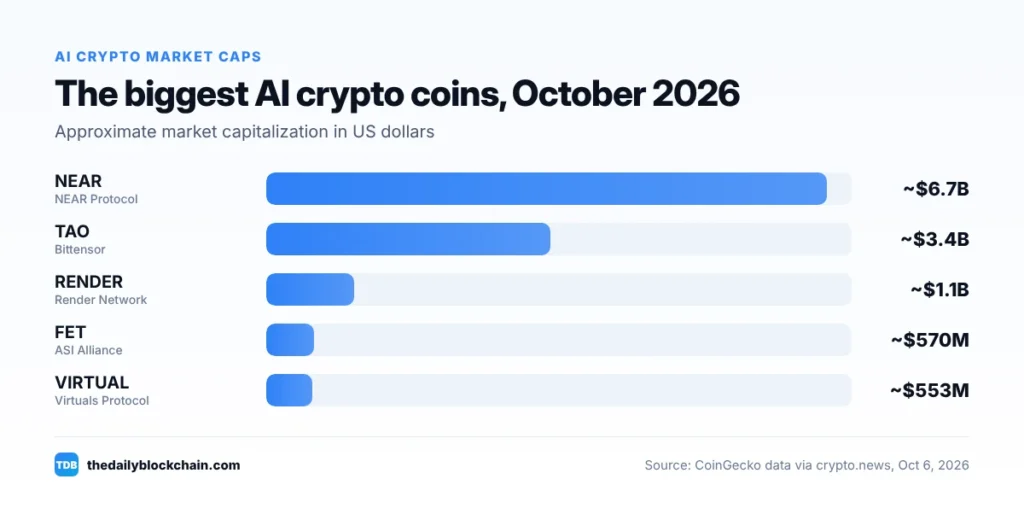
Quick comparison: top AI coins at a glance
Here is how the best AI crypto coins compare on the numbers that matter most before you buy.
| Rank | Project (ticker) | What it does | Approx. market cap (Oct 2026) | Biggest risk |
|---|---|---|---|---|
| 1 | NEAR Protocol (NEAR) | Blockchain for AI agents and cross-chain “intents” | ~$6.7B | Rally driven partly by short liquidations |
| 2 | Bittensor (TAO) | Marketplace that rewards useful machine learning | ~$3.4B | Revenue still hard to verify |
| 3 | Render (RENDER) | Decentralized GPU rendering and AI compute | ~$1B+ | Burns vs. new emissions |
| 4 | Artificial Superintelligence Alliance (FET) | AI agent framework and marketplace | ~$0.53B-$0.57B | Alliance turmoil after Ocean’s exit |
| 5 | Virtuals Protocol (VIRTUAL) | Launchpad and wallets for AI agents | ~$0.55B | Early, speculative adoption data |
| 6 | Akash Network (AKT) | Open marketplace for cloud GPUs | Smaller cap | Competes with hyperscalers on reliability |
| 7 | World (WLD) | Proof-of-personhood for an internet full of bots | Mid cap | Privacy regulation and token unlocks |
1. NEAR Protocol (NEAR): the AI agent chain with the most traction
NEAR started life as a fast, sharded smart-contract blockchain. In 2025 and 2026 it rebuilt its identity around AI: user-owned agents, confidential AI inference, and “chain abstraction” so an agent can act across many blockchains without the user juggling bridges.
Why it ranks first. NEAR’s Intents product, which lets users or AI agents state what they want and lets solvers find the best route, has processed more than 25 million swaps worth around $20 billion since it launched in early 2025, according to figures cited in Grayscale-linked coverage. That is real activity, not a roadmap. NEAR also launched IronClaw, an agent framework built around private, confidential inference, which targets companies that cannot send sensitive data to a public AI model.
Token economics. NEAR cut annual inflation from 5% to 2.5% in October 2025, and a further proposal to lower it to about 1.6% was heading to a vote in early October 2026. Lower inflation means less constant sell pressure from staking rewards.
What to watch. Part of September’s 183% move came from short sellers being forced to buy back, which can reverse quickly. At about $5 per token and a market cap near $6.7B, NEAR is no longer a hidden gem. If you want deeper background on agent payments, our guide to AI agents paying with crypto explains why chains like NEAR are betting on this market.
2. Bittensor (TAO): the purest “decentralized AI” bet
Bittensor is a network where independent miners compete to provide useful machine-learning outputs, and validators score them. The best performers earn TAO. Each specialized market is called a subnet, and there were roughly 128 to 129 of them by late 2025, covering text generation, compute, data storage, AI agents and even deepfake detection.
Why it ranks highly. TAO has Bitcoin-like supply rules: a 21 million cap and halvings. The first halving, on December 14, 2025, cut daily issuance from 7,200 to 3,600 TAO. Wall Street has noticed too. Grayscale’s Bittensor Trust (GTAO) began trading over the counter in December 2025, and Grayscale has filed to list it on NYSE Arca as an exchange-traded product. Bitwise has filed for a TAO product as well. As of early October 2026, TAO traded around $300 with a market cap near $3.4B.
What to watch. A sector analysis published on October 6, 2026 noted that Bittensor still lacks “independent evidence” of commercial deals and revenue. A May 2026 emissions refactor also concentrated rewards in roughly 30 of the most competitive subnets, which is good for quality but means many smaller subnets earn little. For a full walkthrough, read our Bittensor TAO explainer.
3. Render (RENDER): the GPU network with the clearest product
Render connects people who need graphics processing power with people who have idle GPUs. It began with 3D rendering for artists and studios and has expanded into AI compute.
Why it ranks highly. Render’s product is easy to understand and easy to measure. The Render Foundation dashboard showed about 81.8 million total frames rendered and roughly 1.56 million RENDER burned cumulatively as of early October 2026. Render uses a “burn and mint” design: users pay for work, tokens are burned, and node operators are rewarded from new emissions. When usage grows faster than emissions, supply pressure eases.
What to watch. Always compare burns with new emissions over the same period. A burn number on its own tells you nothing about net supply. RENDER traded around $2 with a market cap just above $1B in early October 2026.
4. Artificial Superintelligence Alliance (FET): agents with baggage
FET is the token of the Artificial Superintelligence Alliance, formed in March 2024 when Fetch.ai, SingularityNET and Ocean Protocol agreed to merge their tokens. Fetch.ai’s core product is a framework and marketplace for autonomous AI agents that can search, negotiate and transact.
Why it’s on the list. FET has deep liquidity, broad exchange listings in tier-1 markets, and a long track record in agent technology. Its ASI:Chain roadmap targets a testnet in 2026.
What to watch. The alliance has been messy. Ocean Protocol withdrew on October 9, 2025, and Fetch.ai publicly accused an Ocean-linked wallet of converting about 661 million OCEAN into roughly 286 million FET (about $120 million at the time) and selling much of it, which Ocean denies. FET trades more than 90% below its 2024 all-time high of about $3.45. We dig into the numbers in our Fetch.ai price prediction.
5. Virtuals Protocol (VIRTUAL): the AI agent launchpad
Virtuals lets anyone create, tokenize and run AI agents, mostly on Coinbase’s Base network. In October 2026 it began an invite-only iOS app test in which personal AI agents hold a wallet and trade within limits the user sets.
Why it’s on the list. If AI agents with wallets become mainstream, the platforms where those agents are born could capture a lot of activity. VIRTUAL had a market cap of roughly $553 million in early October 2026.
What to watch. Public adoption and retention data for the new app were not yet available at the time of writing, and many agent tokens launched on the platform are effectively memecoins. Treat this as a high-risk, early-stage position.
6. Akash Network (AKT): an open cloud for AI workloads
Akash is a decentralized marketplace where data centers and individuals rent out computing power, including the high-end GPUs used to train and run AI models. Buyers post what they need and providers bid.
Why it’s on the list. The pitch is price and openness. Akash compute is commonly quoted well below the on-demand rates of big cloud providers, which appeals to startups and researchers squeezed by GPU shortages.
What to watch. Enterprise customers care about uptime, compliance and support, where hyperscalers like AWS still win. Check the network’s own usage dashboards rather than third-party claims, since reported revenue figures vary widely between sources.
7. World (WLD): proof you’re human in an AI world
World, formerly Worldcoin, was co-founded by OpenAI CEO Sam Altman. It uses an iris-scanning device called the Orb to issue a digital ID that proves a person is a unique human without revealing who they are.
Why it’s on the list. As AI-generated accounts flood social media and online services, “proof of personhood” becomes valuable. WLD gained about 47% in September 2026, per Grayscale.
What to watch. Data-protection regulators in several countries have investigated or restricted World’s biometric collection, and large token unlocks have weighed on price in the past. This is as much a regulatory bet as a technology bet.
Which AI crypto will explode in 2026?
This is one of the most searched questions about AI tokens, and the honest answer is that nobody knows, not even for the best AI crypto coins. What you can do is understand what tends to drive big moves:
- Narrative plus catalyst. NEAR’s September run combined a hot narrative (AI agents) with concrete product news and a short squeeze.
- Market regime. AI tokens are high-beta. When Bitcoin, which traded around $82,000 on October 10, 2026, falls sharply, small caps usually fall harder.
- Supply events. Halvings, burns and unlocks change how many tokens hit the market.
- Access. ETF approvals or new listings in the US can bring in fresh capital.
If a website or influencer claims to know which coin will “10x,” treat it as marketing. Our Bitcoin price prediction for 2026 shows how much uncertainty exists even for the largest asset.
Red flags: how to spot fake “AI coins” posing as the best AI crypto coins
The AI label is the easiest way to sell a token in 2026, which is why lists of the best AI crypto coins are full of imposters. so scammers and low-effort projects use it constantly. Walk away if you see:
- No product link. The website talks about “AI-powered” everything but you can’t use anything.
- Borrowed brand names. OpenAI has no token. Any “ChatGPT coin” or “OpenAI token” is not affiliated with the company.
- Guaranteed returns. Real projects don’t promise yields or price targets.
- Anonymous team plus huge insider allocation. Check the token distribution before you buy.
- Liquidity on only one obscure exchange. You may not be able to sell.
Our full guide to AI crypto scams covers deepfake giveaways and fake trading bots in detail.
How to buy the best AI crypto coins safely
- Use a regulated exchange in your country. In the US that means a platform registered with FinCEN and licensed in your state; in the UK, a firm registered with the FCA. Compare options in our best crypto exchanges 2026 guide.
- Check the contract address on the project’s official site if you buy on-chain. Fake tokens often copy the ticker.
- Size the position small. Many investors cap speculative crypto at a low single-digit percentage of their portfolio.
- Move long-term holdings to a wallet you control and protect the recovery phrase offline.
- Keep records for taxes. The IRS treats crypto as property, and US brokers began reporting crypto sales on Form 1099-DA for transactions from 2025. The UK, Canada and Australia also tax crypto gains.
Final verdict
The best AI crypto coins in 2026 share one trait: you can point to something real that the network does. NEAR routes billions of dollars in swaps, Render has rendered tens of millions of frames, and Bittensor has built a working market for machine learning. Everything else on the list is earlier and riskier. If you decide to buy, keep positions small, favor projects with measurable usage, and re-check the numbers every quarter, because rankings of the best AI crypto coins change fast.
Frequently asked questions
What are the best AI crypto coins to buy?
There is no single answer for everyone. By market cap and measurable usage, NEAR, TAO and RENDER led in October 2026, but each carries different risks. Match the project to your risk tolerance and do your own research.
Which AI crypto has the biggest market cap?
As of early October 2026, NEAR Protocol had the largest market cap among the main AI-focused tokens at roughly $6.7B, followed by Bittensor (TAO) at about $3.4B.
Are the best AI crypto coins a good investment?
Even the best AI crypto coins can be a high-risk, high-volatility part of a diversified portfolio. Grayscale’s entire AI crypto sector was worth only about $15B after September’s rally, so a few large trades can move prices sharply in both directions.
Can AI crypto coins reach $10?
It depends entirely on supply. A coin with 2.3 billion tokens in circulation would need a market cap of about $23B to hit $10, which is larger than the whole AI crypto sector today. Always do the market cap math before believing a price target.
Where can I buy AI crypto?
Most of the coins in this list trade on major exchanges that serve the US, UK, Canada and Australia, though availability varies by token and by state or country. Check that the exchange is registered with your local regulator.
Sources and further reading
- Grayscale AI crypto sector gains 54% in September (Crypto Briefing)
- Best AI cryptocurrencies to buy in October 2026: five working theses (crypto.news)
- Bittensor’s first halving (The Block)
- Ocean Protocol withdraws from the ASI Alliance (The Block)
- IRS guidance on digital assets
Disclaimer
This article is for education only and is not financial, investment or tax advice. Crypto assets are highly volatile and you can lose all of your money. Prices and market caps are approximate and change constantly. Always do your own research and consider speaking with a licensed financial adviser.