Last updated: October 10, 2026
An AI crypto trading bot is software that connects to your exchange account and places buy and sell orders automatically, using rules or machine-learning models to decide when to trade. Some genuinely help disciplined traders execute a plan around the clock. Many others are marketing wrappers around simple scripts, and a worrying number are outright scams.
Get offer“Do AI trading bots actually work?” is one of the most common crypto questions on Reddit, usually followed by a dozen replies that say “only for the person selling the bot.” The real answer is more nuanced. This guide breaks down the bot types, what the evidence says, the costs nobody mentions, and a safe way to test one.
Key takeaways
- Most “AI” crypto trading bots are rule-based tools (grid, DCA, arbitrage) with an AI label. True machine-learning or LLM-driven bots are rarer.
- Bots can enforce discipline and trade 24/7, but they cannot predict the future. The CFTC says plainly that AI “can’t predict the future.”
- In a public 2025 test where AI models traded real money, results ranged from +22% to about -63% in roughly two weeks.
- Fees, slippage, subscriptions and taxes can quietly turn a “profitable” bot into a losing one.
- Never give a bot withdrawal permissions, and treat guaranteed returns as a scam signal.
What is an AI crypto trading bot?
At its simplest, a trading bot is a program that watches market data and sends orders to an exchange through an API key you create. The “AI” part can mean very different things:
- Rule-based automation. “Buy $50 of Bitcoin every Monday” or “place buy orders every 1% down and sell orders every 1% up.” No intelligence, just consistency.
- Machine-learning models. Algorithms trained on historical prices, volume, order books or social sentiment to estimate the probability of a move.
- LLM-driven agents. Large language models such as GPT, Claude, Gemini or open-source models that read news and data, then decide on trades. This is the newest and least proven category.
When a product markets itself as an AI crypto trading bot, ask which of these it actually uses. If the answer is vague, that tells you something.
The 5 main types of crypto trading bots
| Bot type | How it works | Works best when | Main risk |
|---|---|---|---|
| Grid bot | Places a ladder of buy and sell orders in a price range | Prices chop sideways | Price breaks out of the range |
| DCA bot | Buys fixed amounts on a schedule or on dips | Long-term accumulation | Averaging down into a long decline |
| Arbitrage bot | Exploits price gaps between exchanges or pairs | Markets are fragmented | Gaps are tiny and competition is fierce |
| Signal or copy bot | Executes trades from a signal provider or another trader | Signals have a real edge | Paying for signals with no edge |
| ML or LLM agent | Uses models to decide entries, exits and sizing | Model has a real, tested edge | Overfitting and unpredictable behavior |
Grid and DCA bots are the workhorses. Several major exchanges now build them in for free, which removes subscription costs and the risk of handing API keys to a third party.
Do AI crypto trading bots actually work?
They “work” in the sense that they execute instructions reliably. Whether they make money depends on whether the strategy has an edge after costs, and that is where most fail.
What a real-money AI test showed
In October 2025, AI research firm Nof1 ran Alpha Arena, giving six leading AI models $10,000 each to trade crypto perpetual futures on the Hyperliquid exchange, with every trade public. When the first season ended in early November, Alibaba’s Qwen3-Max was up about 22.3%, DeepSeek was up about 4.9%, and OpenAI’s GPT-5 had lost about 62.7%, according to the South China Morning Post. Other well-known models also finished with heavy losses.
Two lessons stand out. First, results varied wildly between models given the same market, which suggests luck and risk settings mattered as much as “intelligence.” Second, two weeks is far too short to prove anything. A strategy can win a short contest by taking big leveraged bets and then lose it all in the next.
What Reddit traders report
Reading through long-running threads in communities like r/algotrading and r/CryptoCurrency, a few patterns repeat:
- Grid bots made steady small gains in sideways markets, then got stuck holding coins when prices fell out of the range.
- DCA bots were the most consistently “liked,” mainly because they enforce patience rather than predict anything.
- Paid “AI signal” groups were the most common source of complaints.
- Experienced algorithmic traders say any strategy that works gets copied and stops working, a process called alpha decay.
For a deeper look at the forecasting question, read can AI predict crypto prices?
The hidden costs of using a trading bot
A backtest that shows 40% a year can easily become a loss once you add real-world costs:
- Trading fees. A bot that trades 20 times a day at 0.1% per trade pays a lot of fees.
- Spread and slippage. You rarely get the exact price the backtest assumed, especially on small-cap coins.
- Subscriptions. Many bot platforms charge monthly fees whether or not you make money.
- Funding rates. Bots trading perpetual futures pay or receive funding every few hours.
- Taxes. In the US, the IRS treats crypto as property, so every sale or swap a bot makes can be a taxable event. The UK, Canada and Australia apply capital gains rules too. A bot that trades thousands of times a year creates thousands of tax lines.
Always judge a bot on net return after all of these, compared with simply buying and holding the same coin.
Red flags: how to spot an AI trading bot scam
The CFTC published a customer advisory titled “AI Won’t Turn Trading Bots into Money Machines” after seeing a wave of AI-themed fraud. One case it highlights, Mirror Trading International, allegedly took more than $1.7 billion in bitcoin from at least 23,000 people with promises of AI-driven returns of at least 10% a month. Very little real trading took place.
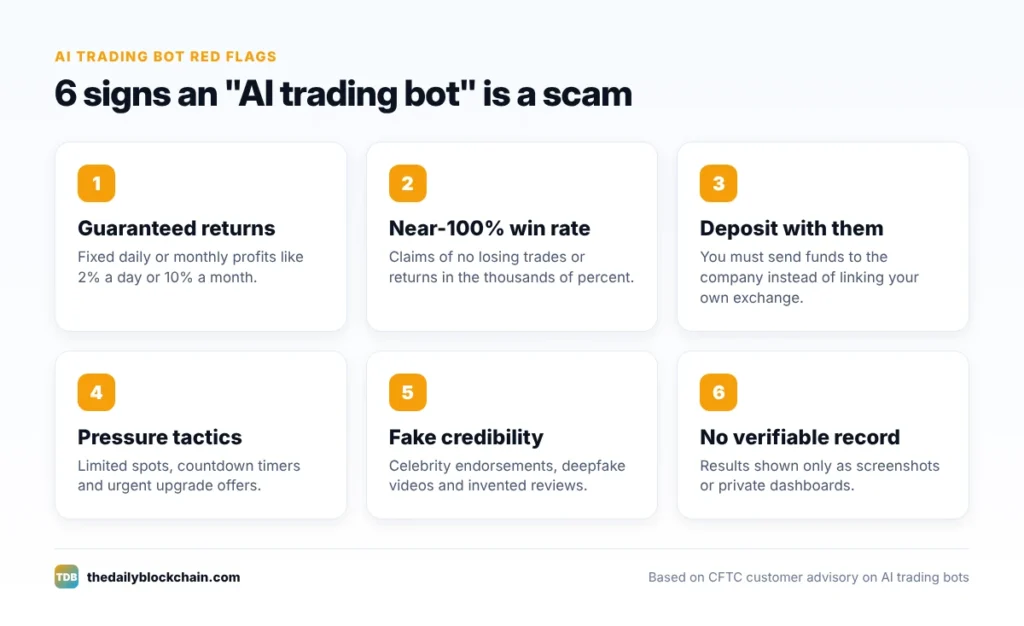
Watch for these warning signs:
- Guaranteed or fixed returns, such as “2% a day” or “10% a month.”
- Win rates near 100% or returns in the thousands of percent.
- You must deposit funds with the bot company instead of connecting your own exchange account.
- Pressure and urgency, such as limited spots or countdown timers.
- Fake credibility, including celebrity endorsements, deepfake videos and invented reviews.
- No verifiable track record, or “results” shown only as screenshots.
If you spot any of these, walk away. Our guide to AI crypto scams explains how fraudsters use deepfakes and fake bot platforms.
How to keep your exchange account safe
Even legitimate bots create security risk, because they need access to your account. In December 2022, the bot platform 3Commas confirmed that a large set of its users’ API keys had leaked, and some users reported unauthorized trades. Protect yourself with these rules:
- Trade-only API keys. Never enable withdrawal permissions for a bot.
- IP whitelisting. Restrict the API key so it only works from the bot provider’s servers.
- Separate sub-account. Fund a sub-account with only what the bot needs.
- Two-factor authentication on the exchange with an authenticator app or hardware key, not SMS.
- Rotate keys regularly and delete any you no longer use.
Our guide on how to keep crypto safe covers wallet security more broadly.
How to test an AI crypto trading bot safely: 7 steps
- Write down the strategy in one sentence. If you can’t explain what the bot does, don’t run it.
- Backtest on data the strategy has never seen. Test on a different time period than the one used to design it.
- Paper trade for at least a month. Many platforms offer demo modes.
- Start with a small amount you’re fully prepared to lose.
- Set a kill switch, such as stopping the bot if the account drops 10%.
- Track net returns versus buy-and-hold, including every fee.
- Review monthly and turn the bot off if the edge disappears.
AI crypto trading bot vs. manual trading
| Factor | Trading bot | Manual trading |
|---|---|---|
| Speed | Reacts in milliseconds, 24/7 | Limited by your attention and sleep |
| Emotions | None, follows rules exactly | Fear and greed affect decisions |
| Adaptability | Struggles when market conditions change | Can adjust to news and context |
| Errors | One bad setting repeats hundreds of times | Mistakes are usually one-off |
| Cost | Subscription, more fees from frequent trading | Fewer trades, lower fees |
The biggest advantage of an AI crypto trading bot is discipline. The biggest weakness is that it keeps doing the same thing even after the market has changed.
Are there any useful AI tools for crypto?
This exact question gets asked on Reddit every few weeks, and the most upvoted answers rarely point to trading bots. Traders say the AI tools they actually keep using are:
- AI chat assistants for summarizing whitepapers, governance proposals and long news threads. See our list of ChatGPT crypto trading prompts.
- On-chain analytics dashboards that use machine learning to label wallets and flag unusual flows.
- Portfolio and tax trackers that categorize thousands of transactions automatically.
- Wallet security tools that simulate a transaction before you sign it and warn about known drainer contracts.
In other words, AI is most useful as a research and safety assistant, not as a money printer.
Who should (and shouldn’t) use a trading bot?
A bot can make sense if you already have a clear, tested strategy, understand the fees and tax consequences, and want to automate execution. It makes far less sense if you’re hoping the bot will supply the strategy for you, if you plan to use leverage, or if the money involved is money you need. Beginners usually get more value from a simple recurring buy than from any AI crypto trading bot.
Are AI crypto trading bots legal?
Using a trading bot on your own account is generally legal in the US, UK, Canada and Australia, as long as the exchange’s terms allow API trading. What matters more is the product you trade. The UK’s FCA, for example, bans the sale of crypto derivatives to retail consumers, so a bot trading leveraged crypto futures may not be available to UK retail users. Selling bot services or managing other people’s money can also require a license.
Frequently asked questions
What is the best AI crypto trading bot?
There is no universally best AI crypto trading bot. For most beginners, free grid or DCA bots built into a regulated exchange are the lowest-risk starting point because there is no subscription and no third party holding your API keys.
Is there a free AI crypto trading bot?
Yes. Several large exchanges offer free built-in grid and DCA bots, and open-source frameworks exist for programmers. “Free” bots still cost trading fees and can still lose money.
Can a trading bot make you rich?
It’s very unlikely. Bots execute strategies; they don’t create an edge. Anyone promising that a bot will make you rich is selling the dream, not a product.
Do AI crypto trading bots work on Coinbase?
Coinbase and other major exchanges offer APIs that many bots support. Check the exchange’s current API documentation and terms, and use trade-only permissions.
Are AI trading bots on Telegram safe?
Treat them with extra caution. Telegram trading bots often require you to give the bot control of a wallet’s private key, which means a bug or a malicious developer could drain your funds.
Sources and further reading
- CFTC: AI Won’t Turn Trading Bots into Money Machines
- Alibaba’s Qwen wins AI crypto trading contest (South China Morning Post)
- AI crypto trading showdown, early results (Decrypt)
- IRS guidance on digital assets
Disclaimer
This article is for education only and is not financial or investment advice. Automated trading can lose money quickly, especially with leverage. Never invest more than you can afford to lose.