
Last updated: October 10, 2026
AI stocks vs AI crypto is the choice facing anyone who wants exposure to the artificial intelligence boom. AI stocks give you ownership in companies with real revenue, regulated markets and investor protections. AI crypto tokens give you a small, early, highly volatile bet on decentralized AI networks, with far less protection. For most investors, stocks are the core and crypto, if used at all, is a small satellite.
The question is more relevant than ever. On Reddit, threads like “Dumping crypto for AI stocks” draw hundreds of comments from crypto holders who watched Nvidia race toward a $6 trillion valuation while their altcoins drifted. Then, in September 2026, AI tokens jumped about 54% in a single month. So which side makes more sense for you? Let’s compare them honestly.
Key takeaways
- Nvidia alone was worth about $5.7 trillion in early October 2026; the entire AI crypto sector was worth roughly $15 billion to $26 billion depending on the definition.
- AI stocks are backed by earnings and regulated disclosures; most AI tokens still lack verified revenue.
- AI crypto can move 50% or more in a month in either direction, which suits only money you can afford to lose.
- Brokerage accounts in tier-1 countries come with protections against firm failure that generally don’t apply to crypto.
- Many investors combine both: AI stocks or ETFs as the core, a small AI crypto allocation as a high-risk satellite.
AI stocks vs AI crypto: the quick comparison
| Factor | AI stocks | AI crypto |
|---|---|---|
| Market size | Trillions of dollars | About $15B-$26B for the whole sector |
| Revenue and profits | Reported quarterly, audited | Usually unverified or token-subsidized |
| Volatility | High for growth stocks | Extreme; 50%+ monthly swings happen |
| Investor protection | Securities laws, broker protection schemes | Limited; varies by country and platform |
| Trading hours | Exchange hours, mostly weekdays | 24/7 |
| Access | Any brokerage, ETFs, retirement accounts | Crypto exchanges, a growing number of ETPs |
| Upside potential | Large companies grow more slowly | Small caps can multiply, or go to zero |
Size: a giant vs. a minnow
The first thing to understand about AI stocks vs AI crypto is scale.
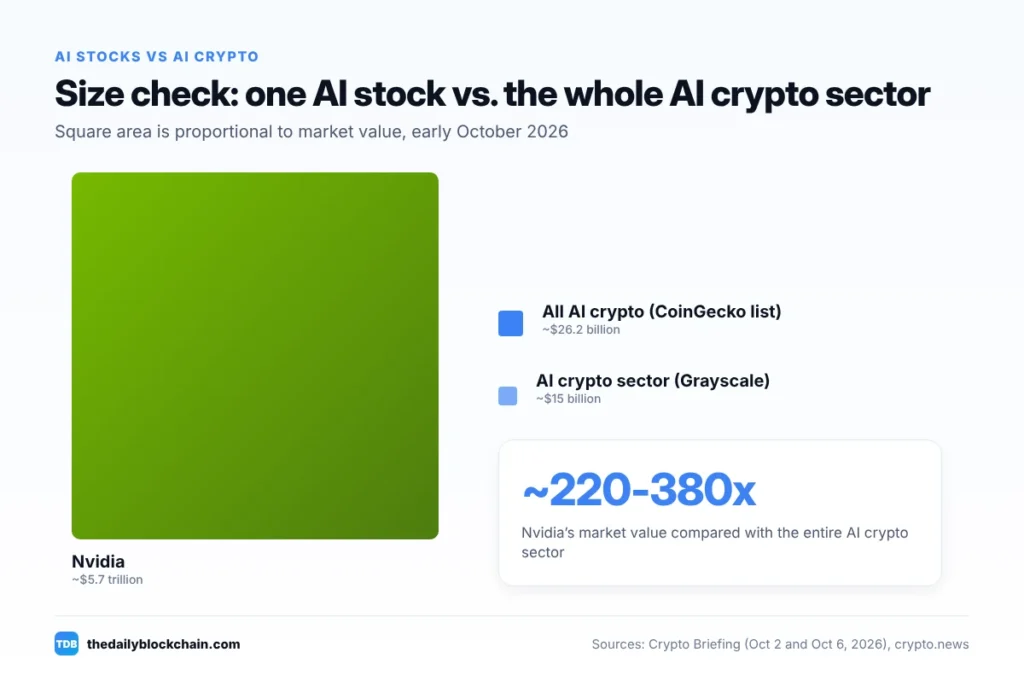
The difference in scale is hard to overstate. Nvidia closed at a record $238.90 on October 5, 2026, putting its market value around $5.7 trillion. Grayscale estimated its AI crypto sector at about $15 billion after September’s rally, and CoinGecko’s broader AI category was about $26.2 billion. Nvidia alone is several hundred times larger than all AI tokens combined.
That gap explains much of the appeal of AI crypto. A small market can grow faster in percentage terms. It also explains the risk: small, thin markets swing violently and can be moved by a handful of large holders.
Revenue: earnings vs. narratives
AI stocks are businesses. Chipmakers, cloud providers and software companies report revenue and profits every quarter, and Nvidia’s quarterly revenue runs into the tens of billions of dollars. You can value them with familiar tools like price-to-earnings ratios, even if those ratios look stretched.
Most AI crypto projects are earlier. Some have measurable usage, such as Render’s tens of millions of rendered frames or NEAR’s billions of dollars in routed swaps. But even Bittensor, the sector’s flagship, was described in an October 2026 analysis as still lacking independent evidence of commercial revenue. When rewards are paid in newly issued tokens, network activity can look busy without anyone paying real money.
This is the single biggest difference in the AI stocks vs AI crypto debate: one side is valued on earnings, the other mostly on expectations.
Volatility and drawdowns
In any AI stocks vs AI crypto comparison, volatility is where the gap feels biggest. Both asset classes are volatile, but on different scales:
- In September 2026, Grayscale’s AI crypto sector rose about 54% and NEAR rose about 183% in one month.
- FET, the token of the Artificial Superintelligence Alliance, fell more than 90% from its 2024 high.
- Leading AI stocks have also had sharp corrections, but large-cap drawdowns are typically smaller and recover with earnings growth.
Ask yourself how you would feel watching a position fall 70%. If the answer is “I’d sell in a panic,” AI crypto should be a very small part of your portfolio, if any.
Investor protection in tier-1 countries
This is where the AI stocks vs AI crypto contest is most one-sided:
- United States: Brokerage accounts at SIPC member firms are protected up to $500,000, including $250,000 for cash, if the broker fails. SIPC doesn’t cover market losses, and it generally doesn’t cover crypto held outside registered securities.
- United Kingdom: The Financial Services Compensation Scheme can cover up to £85,000 per person per firm for eligible investments if an authorized firm fails. Crypto assets are generally not covered.
- Canada: The Canadian Investor Protection Fund covers eligible assets at member dealers if the firm becomes insolvent.
- Australia: There is no broad government-backed scheme for investment platforms, so custody arrangements matter.
When a crypto exchange fails, customers can wait years for partial recovery. Choosing a regulated platform and holding long-term coins in your own wallet reduces, but doesn’t remove, that risk. See our guide to the best crypto exchanges 2026.
The middle ground: ETFs and AI-adjacent stocks
You don’t have to choose between owning tokens directly and owning chip stocks. A few hybrids exist:
- Grayscale Decentralized AI Fund holds a basket including NEAR, TAO, RENDER and FIL.
- Grayscale Bittensor Trust (GTAO) trades over the counter, and Grayscale and Bitwise have filed for US exchange-traded TAO products.
- Grayscale AI Compute ETF (GCPU), formerly a bitcoin miners fund, was renamed on September 22, 2026 and now tracks a high-performance computing index.
- Bitcoin miners pivoting to AI. Several publicly traded miners have repurposed data centers to host AI workloads, creating stocks that straddle both worlds.
These products can be held in regular brokerage accounts, but fees are often higher than plain index funds. Read the prospectus before buying.
Taxes: how AI stocks vs AI crypto are treated
Tax rules differ by country, and you should confirm details with a tax professional:
- US: Both stocks and crypto are subject to capital gains tax. The IRS treats crypto as property, and brokers began reporting crypto sales on Form 1099-DA for 2025 transactions. The wash-sale rule applies to stocks and securities; check current law before assuming it doesn’t apply to crypto, as proposals to extend it have circulated.
- UK: Capital gains tax applies to both, with an annual exempt amount of £3,000. Stocks and many ETFs can be held tax-free inside an ISA, while direct crypto holdings cannot.
- Canada: Capital gains on both are taxed at a 50% inclusion rate for individuals. Crypto ETFs can be held in a TFSA or RRSP.
- Australia: Both are subject to capital gains tax, with a 50% discount for individuals who hold an asset for more than 12 months.
Tax-advantaged accounts are a meaningful edge for AI stocks and ETFs over direct crypto ownership.
Who should choose AI stocks?
- You want AI exposure as a long-term core holding.
- You value audited financials and regulatory protection.
- You invest through retirement or tax-advantaged accounts.
- You prefer lower, though still meaningful, volatility.
Who might add AI crypto?
- You already have a diversified core portfolio.
- You understand wallets, exchanges and crypto security.
- You can tolerate losing most or all of the amount invested.
- You want exposure to decentralized AI infrastructure, which AI stocks don’t offer.
If that’s you, our ranking of the best AI crypto coins of 2026 and our explainer on what AI crypto is are good next reads.
A simple core-and-satellite approach
Many investors split the decision rather than choosing one side:
- Core: a broad index fund or AI-focused stock ETF that holds established companies.
- Satellite: a small slice in AI crypto, often a low single-digit percentage of the total portfolio.
- Rebalance: once or twice a year, trim whichever side has grown beyond its target.
This way, a 90% crash in a token is painful but survivable, and a 10x gain still matters.
5 questions to settle AI stocks vs AI crypto for yourself
- What do I actually believe about AI? If you think the biggest winners will be chipmakers, cloud platforms and software giants, that’s a stock thesis. If you think open, decentralized networks will take meaningful share from Big Tech, that’s a crypto thesis.
- What’s my time horizon? Money you need within a few years doesn’t belong in assets that can fall 80%.
- Which accounts can I use? If most of your investing happens in a 401(k), IRA, ISA, TFSA or super fund, AI stocks and ETFs fit naturally.
- Can I secure crypto properly? Self-custody means protecting a recovery phrase; exchange custody means trusting a company.
- How will I measure success? Decide in advance what would make you add, hold or sell, so headlines don’t decide for you.
Writing down your answers turns AI stocks vs AI crypto from a gut call into a plan.
Lessons from the dot-com era
Every technology boom produces a few enduring winners and thousands of losers. In the late 1990s, investors who bought broad internet exposure often did fine over the long run, while many who chased small, story-driven names lost almost everything. The same pattern is likely to play out in AI. Large AI stocks resemble the established platforms of that era; most AI tokens resemble the small, unproven startups. Some will become important. Many won’t survive.
Should you sell crypto to buy AI stocks?
That depends on why you own crypto in the first place. If you bought altcoins as a bet on AI and now realize you wanted exposure to companies with earnings, moving some money into AI stocks may better match your goals. If you hold Bitcoin as a long-term store of value, it serves a different role than an AI stock. Selling also triggers taxes in most tier-1 countries, so factor in the bill before switching. The AI stocks vs AI crypto decision isn’t all-or-nothing.
Frequently asked questions
Is AI crypto riskier than AI stocks?
Yes, in almost every way. AI crypto is smaller, less regulated, more volatile and mostly lacks verified revenue. AI stocks carry risk too, but they’re backed by real businesses and investor protections.
Can I buy AI crypto through an ETF?
In the US you can buy some funds that hold AI tokens, such as Grayscale’s Decentralized AI Fund and Bittensor Trust, which trade over the counter. Exchange-listed TAO products had been filed but were awaiting approval as of October 2026.
Which is better for beginners, AI stocks or AI crypto?
For most beginners, AI stocks or a diversified AI ETF are the simpler, safer starting point. Learn how crypto custody and taxes work before buying tokens.
Do AI crypto tokens move with AI stocks?
Often, yes. AI tokens tend to rally when AI stocks and the broader tech market are strong, and they usually fall harder in sell-offs. They also move with Bitcoin, which traded around $82,000 in early October 2026.
How much of my portfolio should be in AI crypto?
There’s no universal answer, and this isn’t personal advice. Many financial planners suggest keeping speculative crypto to a small percentage of a portfolio, sized so that a total loss wouldn’t change your life plans.
Sources and further reading
- Nvidia nears $6 trillion market cap (Crypto Briefing)
- Grayscale AI crypto sector gains 54% in September (Crypto Briefing)
- SIPC: What SIPC protects
- FSCS investment protection (UK)
- IRS guidance on digital assets
Disclaimer
This article is for education only and is not financial, investment or tax advice. Stocks and crypto can both lose value, and crypto can lose all of its value. Consider speaking with a licensed financial adviser before making investment decisions.